Count to 10
Touch each picture once; the last number tells how many.
Example: five dots counted 1, 2, 3, 4, 5 make a group of 5.
Counting worksheets help children connect objects, number names and written numerals. Start with groups to 10, move to 20, then practice counting on and sequences to 100.
Choose from seven skills below for pre-K preparation, kindergarten practice or grade 1 review, with a worked example for each.
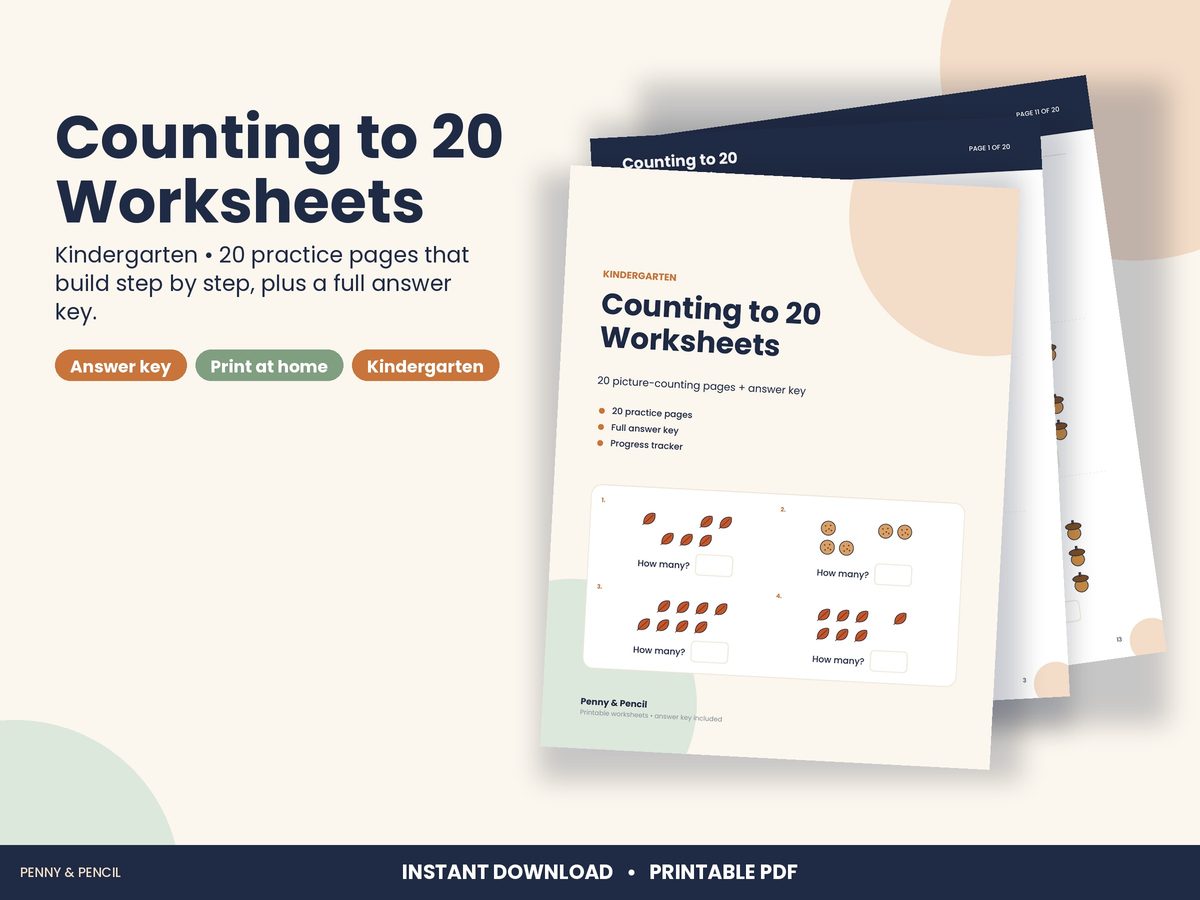
Get the seven counting worksheets (PDF)Want more picture-counting practice? Counting to 20 Worksheets has 20 practice pages, a full answer key and a progress tracker.
Buy Counting to 20 Worksheets on Etsy · $5.50Use the first sheet your child can attempt comfortably, rather than completing every level at once. The examples show the method; the downloadable sheets have different questions.
Touch each picture once; the last number tells how many.
Example: five dots counted 1, 2, 3, 4, 5 make a group of 5.
Move from one row to the next without counting any dot twice.
Example: one full row of 10 dots and 4 more dots gives 14.
Count a group, then circle the numeral that names its quantity.
Example: a group of 6 dots matches the numeral 6, even if the dots move.
Keep the starting number and say the next numbers instead of restarting at 1.
Example: start at 7 and count on three numbers: 8, 9, 10.
Each next number is one more, including across a new ten.
Example: after 38 come 39, 40, 41; the ones restart at zero in 40.
Name the full tens in order from 10 through 100.
Example: 10, 20, 30, 40 names one, two, three, then four groups of ten.
Check the number before and after each space to keep the sequence in order.
Example: 16, __, 18 needs 17 because it is one after 16 and one before 18.
Try small groups on the count-to-10 and matching sheets with an adult. This is a practice suggestion, not a Common Core pre-K requirement.
K.CC.B.4 connects one number name to each object and the final number to the total. K.CC.B.5 includes counting up to 20 arranged objects or up to 10 scattered objects.
K.CC.A.1 covers the sequence to 100 in ones and tens; K.CC.A.2 starts a forward count from a given number; K.CC.A.3 connects numerals 0–20 with quantities. Missing-number work is a way to practice these sequences.
Grade 1 extends counting, numeral reading and writing, and representing quantities through 120, starting below 120. These sheets stop at 100, so they support review rather than cover the whole standard.
Get the counting answer keys (PDF) after joining the list; each key repeats its practice sheet with the answers filled in. Print only the skill you need.
For jumps by 2, 5 or another interval, use our skip counting worksheets. For worked examples and practice across all five Common Core K domains, visit kindergarten math worksheets.
Official standards read November 18, 2026. The grade mapping is paraphrased from these sources; practice questions and worked examples are Penny & Pencil originals.
Find the unknown part with our missing addend worksheets, with counting-on examples and practice sets with keys.
Practise counting up from a cost to the amount paid with our making change worksheets, with US coin and bill examples.
Explore our kindergarten math centers with a worked example and email-list printable.
The free download opens when you join our list: join below.
Join the Penny & Pencil list once, confirm the email we send, and every free download, printable and planner on this site opens. We send a welcome note, deals, and one email every two weeks. Unsubscribe any time.
You are in. Your free downloads are unlocked on this page.