Area and Perimeter: How to Calculate Each Without Mixing Units
Perimeter is the total distance around a shape; area measures the surface inside it. For an 8 cm by 5 cm rectangle, perimeter is 2 × (8 + 5) = 26 cm, while area is 8 × 5 = 40 cm².
In an original rectangle example, the long side is 8 cm and the short side is 5 cm. Opposite sides match, so the boundary has lengths 8, 5, 8 and 5 cm. Adding those lengths measures the perimeter; multiplying the two side lengths counts square centimeters inside.
Rectangle: 8 cm by 5 cm
Measurement
Calculation
Result
Perimeter
8 + 5 + 8 + 5
26 cm
Area
8 × 5
40 cm²
Split a composite shape into non-overlapping rectangles
Imagine an 8 cm wide, 6 cm tall rectangle with a 3 cm wide by 2 cm tall corner removed from its upper right. The resulting L-shape has a 5 cm top horizontal edge and a 4 cm right outer vertical edge.
Area by subtraction is 8 × 6 − 3 × 2 = 48 − 6 = 42 cm². To check with two pieces, use the bottom 8 cm by 4 cm rectangle and the upper-left 5 cm by 2 cm rectangle: 32 + 10 = 42 square centimeters. The two pieces share an edge but no interior area.
Trace every exposed edge for composite perimeter
Walk clockwise from the lower left: 8 cm along the bottom, 4 cm up the right, 3 cm left along the notch, 2 cm up its inner edge, 5 cm left along the top and 6 cm down the left. The total is 8 + 4 + 3 + 2 + 5 + 6 = 28 cm.
Do not add the rectangles’ perimeters without removing shared internal edges. For the two-piece split, their perimeters are 24 cm and 14 cm; the shared 5 cm edge was counted twice, so 24 + 14 − 10 = 28 cm.
Pencil’s unit check: which answer needs a square?
A fence follows a boundary, so its length uses cm in this drawing. Covering the inside counts unit squares, so the area uses cm². A numerical answer without its unit hides which measurement was made.
Convert measurements before combining them
If one side is 1 m and the other is 50 cm, write both in centimeters: 100 cm and 50 cm. The rectangle’s area is 5,000 cm² and its perimeter is 300 cm. Do not multiply 1 by 50 and label the result square meters.
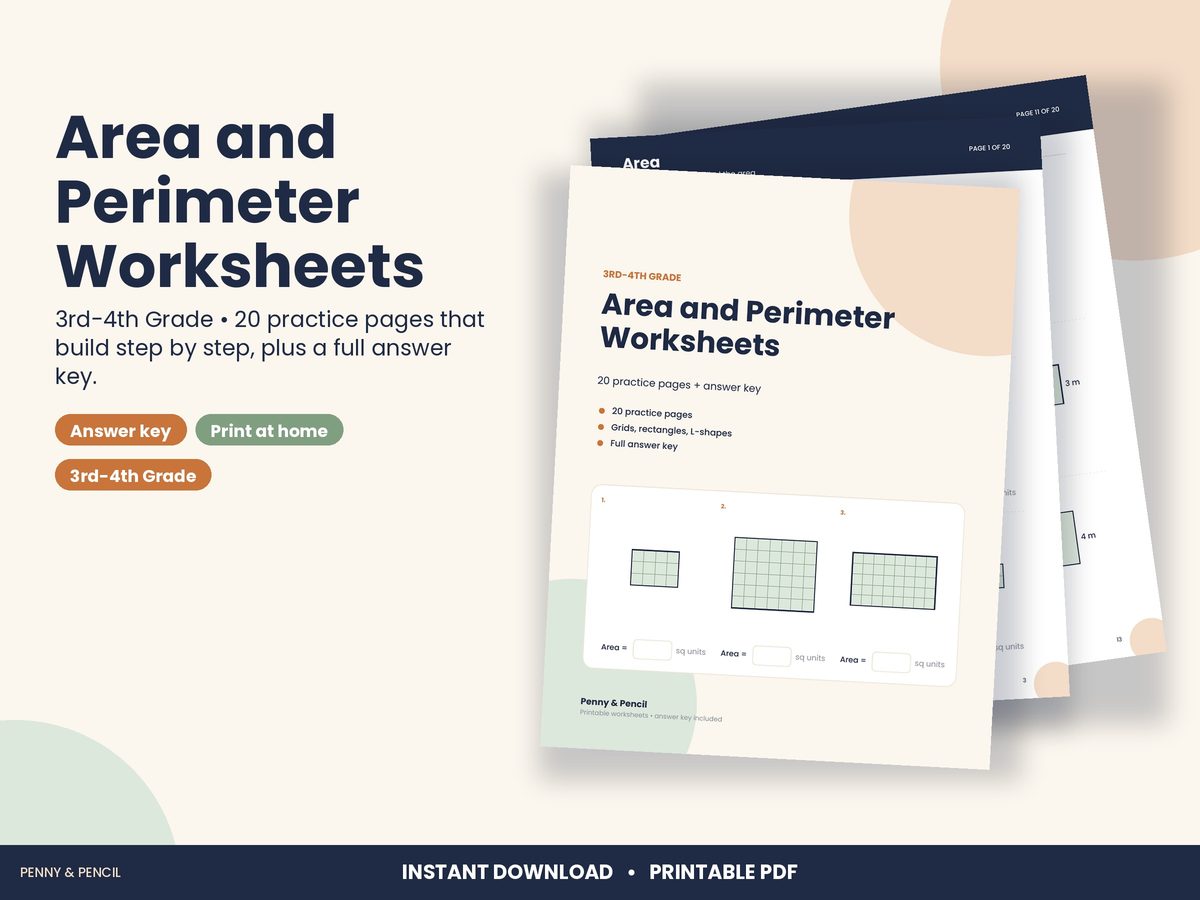
The Area and Perimeter Worksheets offer practice with answer keys. The method here uses explicitly labeled lengths so the boundary and interior calculations stay separate.
Worked numbers, tables and teaching examples are original illustrations, not customer records.
The free download opens when you join our list: join below.
Free downloads unlock when you join our list
Join the Penny & Pencil list once, confirm the email we send, and every free download, printable and planner on this site opens. We send a welcome note, deals, and one email every two weeks.
You are in. Your free downloads are unlocked on this page.