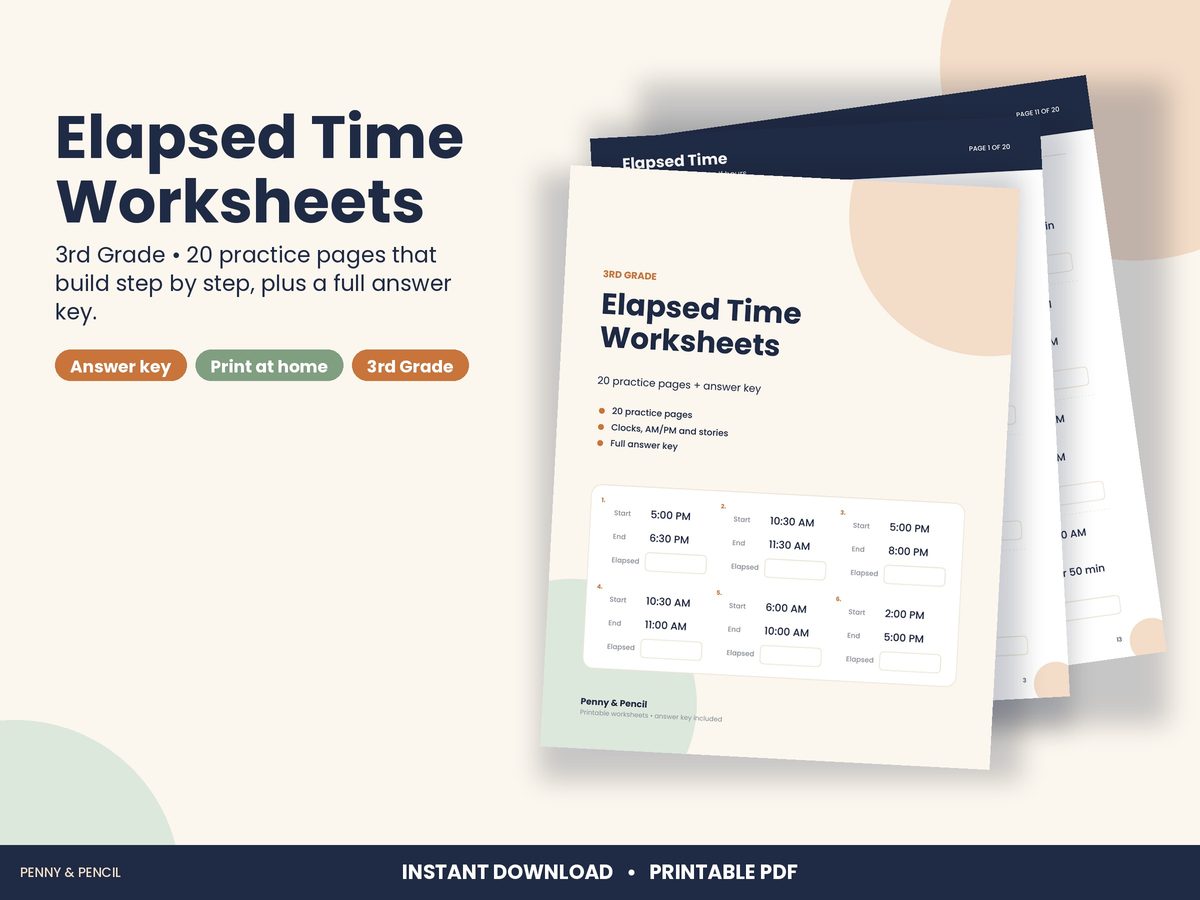
How to Teach Elapsed Time: Count Forward Across an Hour
Teach elapsed time by marking a start and an end, counting forward to the next hour, then adding the remaining minutes. From 9:45 a.m. to 10:20 a.m., count 15 minutes to 10:00 and 20 more to 10:20: the duration is 35 minutes.
A clock reading answers when an event happens; elapsed time answers how long it lasts. Place start and finish labels on a drawn timeline and ask the learner to point to the interval between them before doing arithmetic.
Original forward-jump lesson; same-day events
Start → end
Jumps in minutes
Duration
8:40 → 9:15 a.m.
20 + 15
35 minutes
11:50 a.m. → 12:25 p.m.
10 + 25
35 minutes
1:35 → 3:10 p.m.
25 + 60 + 10
95 minutes
Cross noon explicitly
For the second row, move ten minutes from 11:50 a.m. to noon, then twenty-five to 12:25 p.m. Label noon 12:00 p.m.; the change from a.m. to p.m. does not add another hour. Draw each jump with its length above the arrow.
Build an hour from minutes
Use sixty small marks or a clock minute scale to show why 95 minutes is 60 + 35, or 1 hour 35 minutes. Subtracting written clock digits as ordinary decimals can produce the wrong unit; one hour is sixty minutes, not one hundred.
Check by returning to the end time
Give 2:48 p.m. as a start and 3:12 p.m. as a finish. A learner can jump 12 minutes to 3:00 and 12 more to get 24 minutes. Add that duration to the start to verify the endpoint. State the day when an event could cross midnight.
Worked numbers, tables and teaching examples are original illustrations, not customer records.
The free download opens when you join our list: join below.
Free downloads unlock when you join our list
Join the Penny & Pencil list once, confirm the email we send, and every free download, printable and planner on this site opens. We send a welcome note, deals, and one email every two weeks. Unsubscribe any time.
You are in. Your free downloads are unlocked on this page.