Worked example: build a whole
Parts 3 and 5 make whole 8 because 3 + 5 = 8. Swapping the parts gives 5 + 3 = 8; the whole stays the same.
A number bond splits one whole into two parts: 8 is the whole, and 3 and 5 are its parts. Our free worksheets practise bonds to 5, 10 and 20, missing parts, and addition–subtraction fact families.
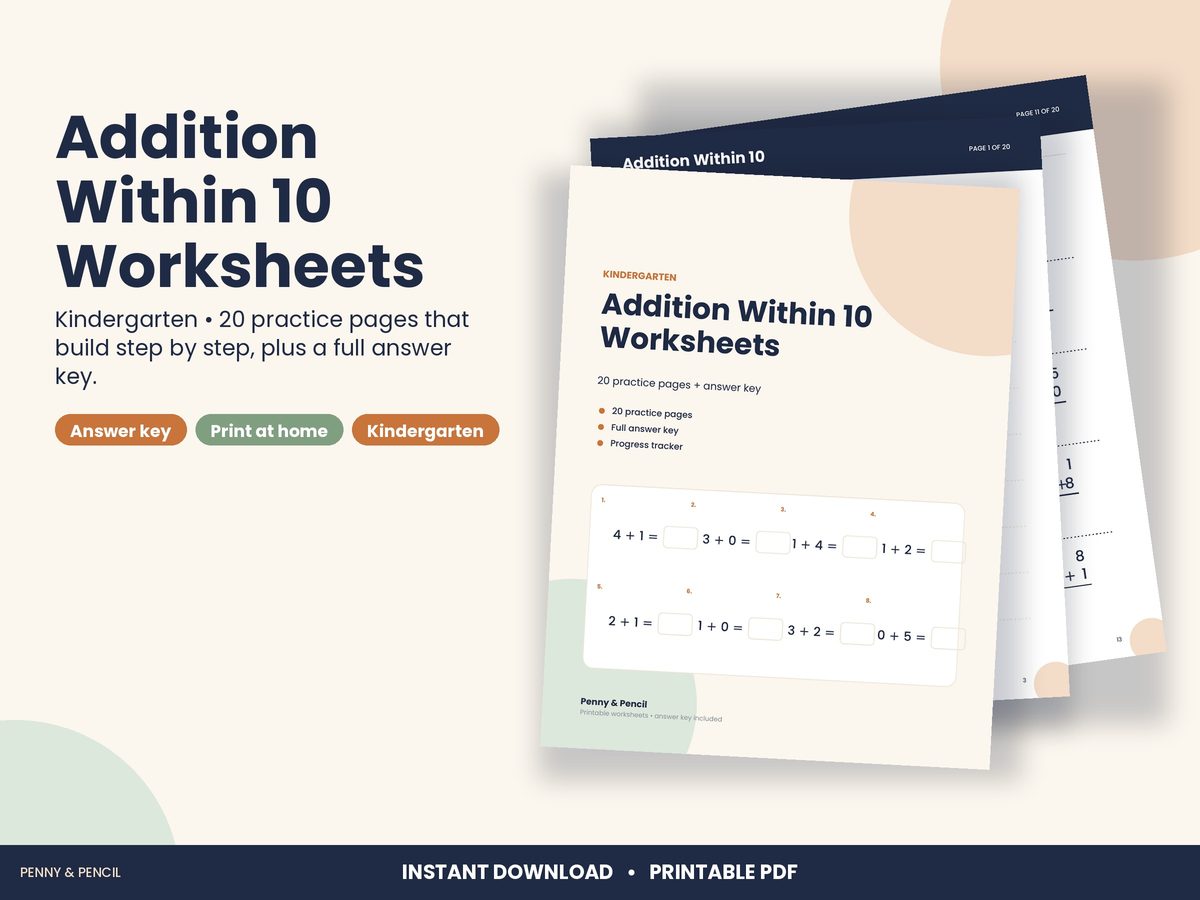
Get the number bonds worksheets and keys (PDF)Keep practising within 10: Addition Within 10 Worksheets has 20 practice pages covering sums to 5 and 10, stacked addition and missing numbers, plus a full answer key.
Buy Addition Within 10 Worksheets on Etsy · $5.50Put 8 counters in the whole circle, then move 3 into one part and 5 into the other. The two part circles connect to the whole; neither part is a second total.
Parts 3 and 5 make whole 8 because 3 + 5 = 8. Swapping the parts gives 5 + 3 = 8; the whole stays the same.
Whole 8 and known part 3 leave a missing part of 5: 8 − 3 = 5. Check by adding the parts back together.
Each of the first four sheets has six labelled bond diagrams; the fact families sheet has four bonds with space for four equations each. The keys show completed diagrams and checking equations.
Start with counters and small wholes from 3 to 5. Example: whole 5, part 2, missing part 3; 2 + 3 = 5.
Keep the whole fixed at 10 and change the parts. Example: 4 needs 6 more, so 4 + 6 = 10; include 0 + 10 as well.
Use wholes from 12 to 20 for a larger-number challenge. Example: split 18 into 10 and 8; 18 − 10 = 8.
Notice which circle is empty before choosing an operation. Example: parts 5 and 8 give whole 13; whole 17 and part 9 leave part 8.
For whole 9 and parts 2 and 7, the family is 2 + 7 = 9, 7 + 2 = 9, 9 − 2 = 7, and 9 − 7 = 2. Addition joins the parts; subtraction starts with the whole and removes one part.
The final practice sheet uses four bonds with unequal parts so all four equations are different. Equal parts repeat facts: the bond 6, 3, 3 has only two distinct equations, 3 + 3 = 6 and 6 − 3 = 3.
Yes! A whole of 5 can split into 0 and 5: moving every counter into one part leaves the other part empty.
Standards checked November 18, 2026. These are practice connections; Common Core does not require this particular circle diagram or a fixed worksheet sequence.
Decompose numbers up to 10 into pairs in more than one way, using objects or drawings and recording the splits. Start with the to-5 sheet, then try the to-10 sheet.
B.3 uses properties of operations as addition and subtraction strategies; swapping addends connects to fact families. B.4 treats subtraction as finding an unknown addend, connecting to missing-part bonds.
Add and subtract within 20, with fluency within 10, using strategies such as making ten and relating addition to subtraction. The to-20 and mixed sheets extend that practice.
For a five-domain overview covering teen numbers, measurement and shapes alongside number skills, see our kindergarten math worksheets.
Official standards read November 18, 2026; worksheet questions and worked examples are original Penny & Pencil practice material.
Find the unknown part with our missing addend worksheets, with counting-on examples and practice sets with keys.
Explore our picture addition worksheets with a worked example and email-list printable.
The free download opens when you join our list: join below.
Join the Penny & Pencil list once, confirm the email we send, and every free download, printable and planner on this site opens. We send a welcome note, deals, and one email every two weeks. Unsubscribe any time.
You are in. Your free downloads are unlocked on this page.