Order of Operations: How to Evaluate an Expression Step by Step
Use grouping first, then powers, then multiplication and division from left to right, then addition and subtraction from left to right. Example: 18 ÷ 3 × 2 is 6 × 2 = 12, not 3.
Start with 30 − 2 × (3 + 1)2 ÷ 4 + 5. Rewrite the whole expression after each change so an untouched number or sign is not lost.
One operation level per line
Step
Expression after the change
Original
30 − 2 × (3 + 1)² ÷ 4 + 5
Grouping
30 − 2 × 4² ÷ 4 + 5
Power
30 − 2 × 16 ÷ 4 + 5
Multiply leftmost
30 − 32 ÷ 4 + 5
Divide next
30 − 8 + 5
Subtract leftmost
22 + 5
Add
27
Multiplication and division have equal priority
In 24 ÷ 4 × 2, first calculate 24 ÷ 4 = 6, then 6 × 2 = 12. Treating multiplication as always earlier would instead create a denominator of 8, but the original expression has no grouping around 4 × 2.
Addition and subtraction also run left to right
For 20 − 6 + 2, subtract first to get 14, then add 2 for 16. Adding 6 and 2 first would change the expression into 20 − (6 + 2), which asks a different question.
Read powers and negative signs carefully
The grouping in (−3)2 makes the negative number the base, so the result is 9. In −32, evaluate the square of 3 before applying the leading minus, giving −9. Keep parentheses when copying a negative base.
Pencil’s expression check: 8 + 12 ÷ 3
Divide 12 by 3 to get 4, then add 8: the value is 12. Adding first would incorrectly replace the written expression with (8 + 12) ÷ 3.
Check the rewritten line, not just the final number
Match each unchanged term to the previous line.
Resolve the innermost group before an outer group.
Mark powers before choosing a multiplication or division step.
When a priority level has several operations, move left to right.
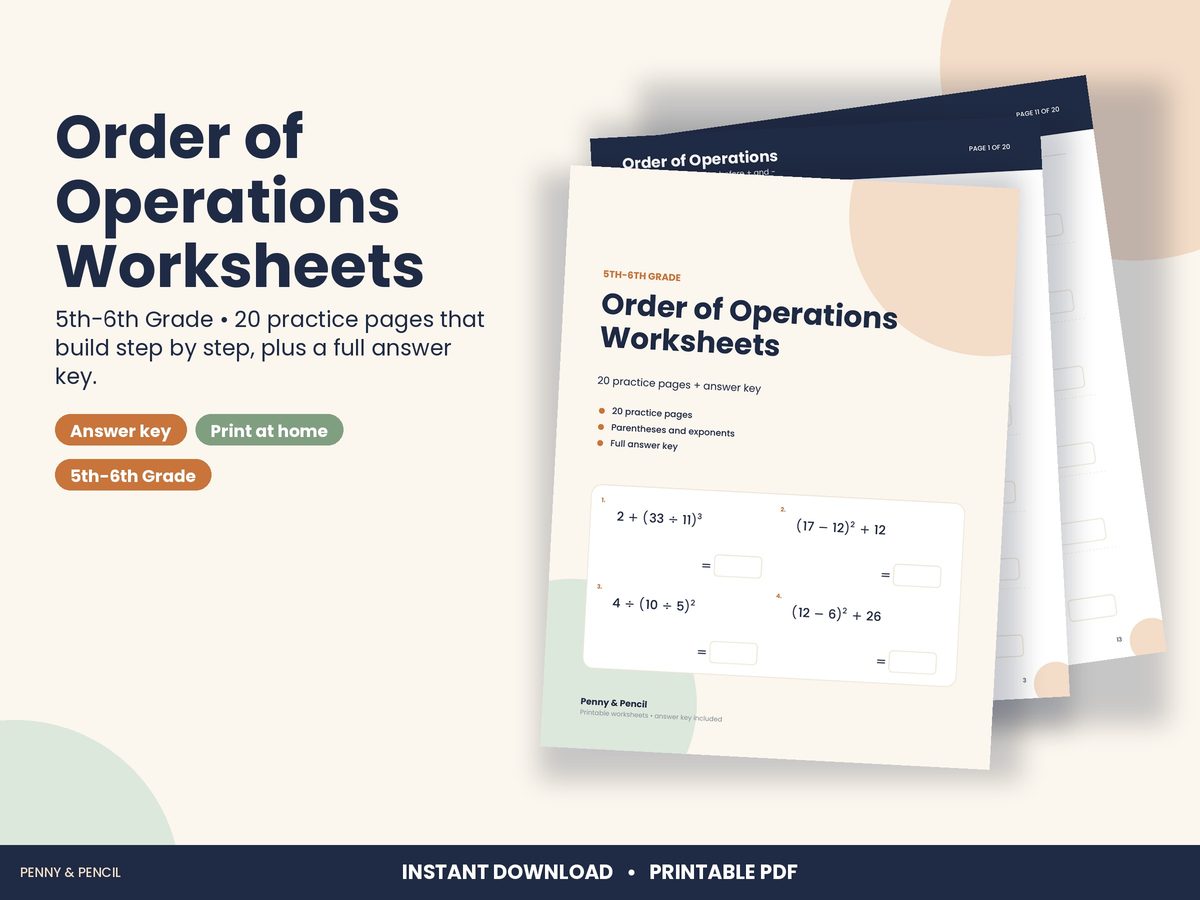
The Order of Operations Worksheets supply practice and answer keys; the worked expressions on this guide teach the method separately from the catalog.
Worked numbers, tables and teaching examples are original illustrations, not customer records.
The free download opens when you join our list: join below.
Free downloads unlock when you join our list
Join the Penny & Pencil list once, confirm the email we send, and every free download, printable and planner on this site opens. We send a welcome note, deals, and one email every two weeks.
You are in. Your free downloads are unlocked on this page.