Choose a Math Review Packet: Skills, Examples and Answer Checks
Choose a math review packet by matching one already-taught skill to its sample questions, number range and answer key. For example, a learner reviewing 62 minus 28 needs subtraction with regrouping; check the answer 34 by adding 34 and 28 to rebuild 62.
A useful packet revisits something already taught and makes it easy to see the step a learner needs to practice. Start with a recent assignment: name the skill that caused difficulty, then look at actual sample pages and the answer key before choosing a pack.
Choose one target, such as subtracting across a ten, rather than every topic at once.
Read two sample questions. Check number size, operation, directions and room to show work.
Look for a matching answer key and check whether models or explanations are included or need to be supplied by you.
Choose a short section for the first session. Record whether the learner worked alone, used a hint or needed a model.
The best math review packet for a particular session is the one that matches the learner’s current task. A grade label is a starting filter; inspect the exercises themselves. The comparison below illustrates different targets, not a single packet that contains all of them.
Skills, examples and answer checks
Match the packet to recent work, rather than its cover
Skill to revisit
Example and answer check
Place value
In 346, the 4 means 40. Check: 300 + 40 + 6 = 346.
Regrouping in addition
47 + 26 = 73. Check: 73 − 26 = 47.
Regrouping in subtraction
62 − 28 = 34. Check: 34 + 28 = 62.
Equal groups
4 groups of 6 make 24. Check: 24 ÷ 4 = 6.
Like-denominator fractions
2/7 + 3/7 = 5/7. Check: 5/7 − 3/7 = 2/7.
These are original worked examples to show how to inspect a packet. They are not a placement test, grade-level standard or a promise about what the paid pack includes.
Work through a regrouping example before assigning a page
For 47 + 26, combine seven ones and six ones to make thirteen ones. Exchange ten ones for one ten, leaving three ones. Four tens plus two tens plus the exchanged ten make seven tens, so the sum is 73.
For 62 − 28, exchange one of the six tens for ten ones: five tens and twelve ones remain. Twelve ones minus eight ones gives four ones; five tens minus two tens gives three tens. The answer is 34.
Pencil’s answer check: why add after subtracting?
The removed part plus the remaining part should rebuild the starting quantity. Here, 28 + 34 = 62. If that sum differs, inspect the exchange and the copied digits before doing another whole page.
Keep a small review record
Before practice: write the target and one question the learner can explain.
During practice: note whether the difficulty was reading directions, understanding a model, calculating or copying.
After checking: revisit one incorrect question and have the learner explain the correction.
Next session: choose a similar question and note which steps can now be completed independently.
A correct final number alone does not show every step. Ask for a picture or explanation when you need to understand the method, and keep “with help” separate from independent work in your notes. This procedure does not set a pass mark or guarantee progress.
Try a sample, then check the paid pack’s scope
The existing list-gated Thanksgiving sample is a separate addition-with-regrouping worksheet with an answer key. It lets you inspect that kind of exercise; it is not the full paid pack or a review of every skill in the table.
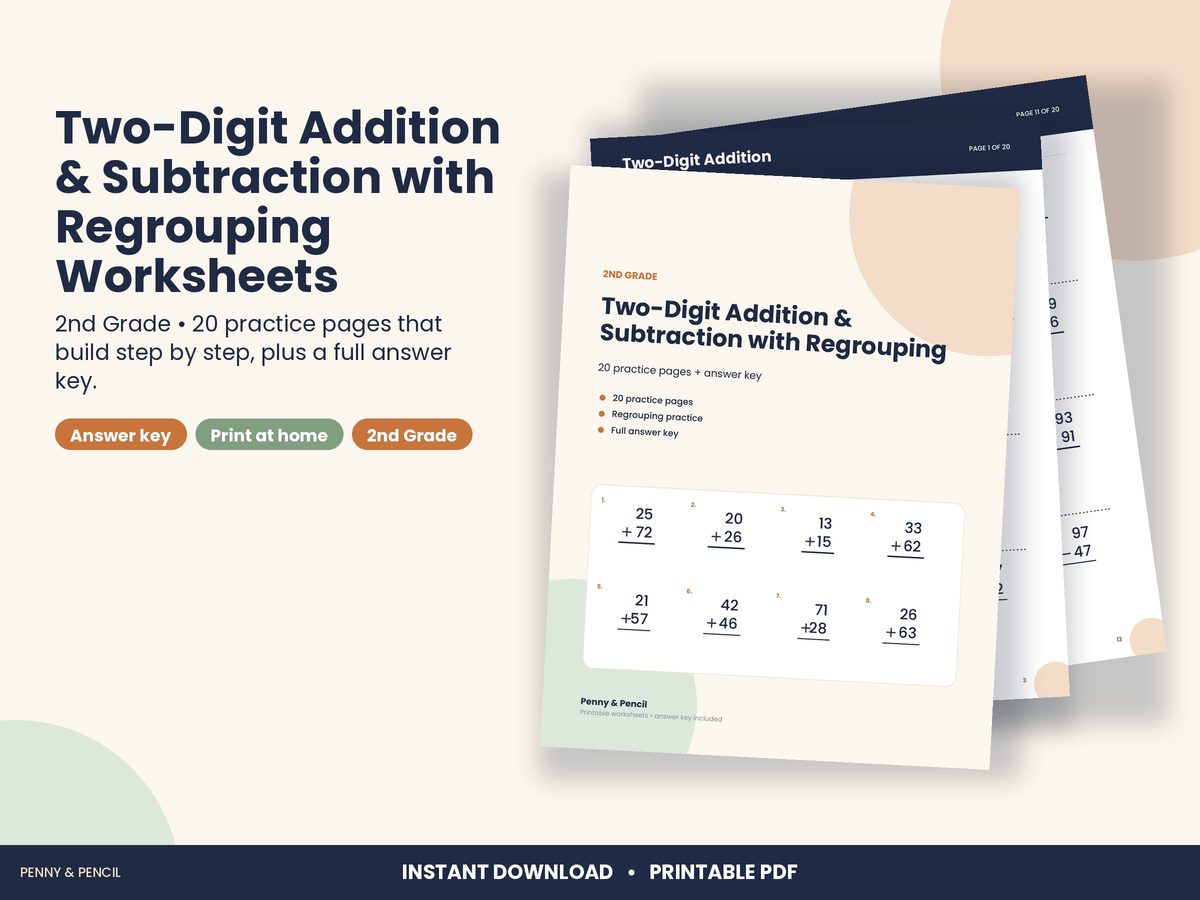
The Two-Digit Addition & Subtraction with Regrouping Worksheets pack is a printable PDF with 20 practice pages and matching answer keys, moving from no regrouping to carrying, borrowing and mixed practice. Choose it when those operations match the review target. Its license covers personal use or one classroom.
The free download opens when you join our list: join below.
Free downloads unlock when you join our list
Join the Penny & Pencil list once, confirm the email we send, and every free download, printable and planner on this site opens. We send a welcome note, deals, and one email every two weeks.
You are in. Your free downloads are unlocked on this page.