Same denominator: count the parts
Example: 3/8 < 5/8. Both pieces are eighths, so five pieces cover more of the whole than three. Draw two equal bars, cut each into eight equal parts, and shade the two amounts.
Compare fractions of the same whole. With equal denominators, the larger numerator wins; with equal positive numerators, the smaller denominator gives the larger fraction. Otherwise, compare with one half or rename both fractions with a common denominator.
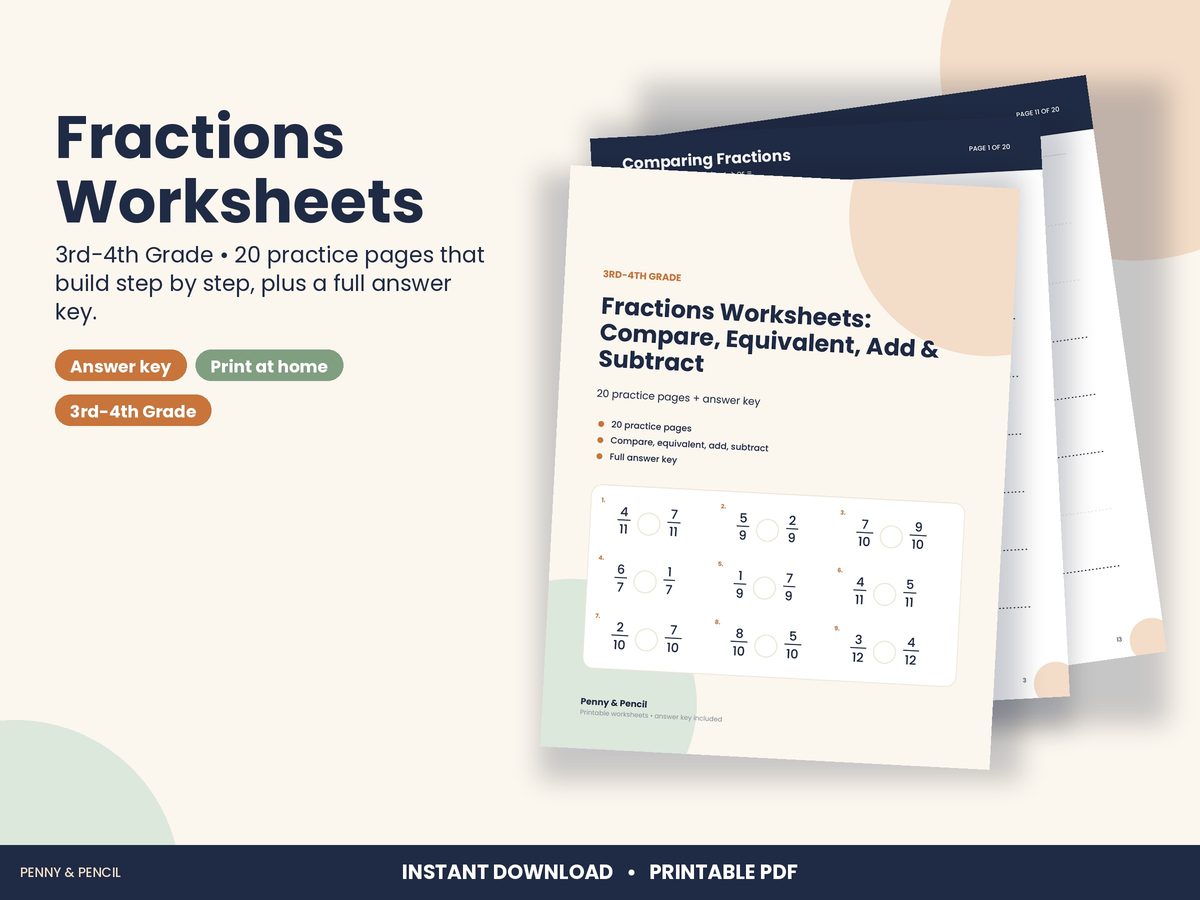
Get comparing fractions practice and keyBuild the fraction foundations: Fractions Worksheets has 20 practice pages and a matching answer key for grades 3–4, including comparing, equivalent fractions and like-denominator addition and subtraction.
Buy Fractions Worksheets on Etsy · $6.00Example: 3/8 < 5/8. Both pieces are eighths, so five pieces cover more of the whole than three. Draw two equal bars, cut each into eight equal parts, and shade the two amounts.
Example: 2/3 > 2/6. Thirds are larger than sixths of the same whole, and you have two pieces in either case. A larger denominator alone does not mean a larger fraction.
Example: 3/8 < 5/6. Half of eight is four, so 3/8 is below one half. Half of six is three, so 5/6 is above it. If both fractions are on the same side of one half, this check alone may not decide their order.
Example: 2/3 and 3/4 become 8/12 and 9/12. Multiply both numbers in 2/3 by 4 and both numbers in 3/4 by 3. Since 8 < 9, 2/3 < 3/4.
For positive denominators, compare the cross-products: 2 × 4 = 8 and 3 × 3 = 9 confirm that 2/3 < 3/4. This is the common-denominator method with denominator 12 left unwritten; explain the fraction sizes before using the shortcut.
Equality matters too: 2/3 = 4/6 because each third is split into two sixths. Do not force a greater-than or less-than answer when the two values match.
Six same-numerator or same-denominator pairs use thirds, fourths, sixths and eighths. Explain a pair with two equal-sized bars.
Six pairs can be compared with one half, including an equality. Label a number line with zero, one half and one.
Six comparisons use different denominators. Show equivalent fractions, then verify the sign with cross-products.
The list-gated PDF includes all 18 signs on its final key page; a correct sign still needs a model or explanation in the working space.
Official standards checked November 19, 2026. In grade 3, 3.NF.A.3.d compares fractions with a shared numerator or denominator, records a symbol and asks for justification; the domain uses denominators 2, 3, 4, 6 and 8. Set 1 follows that boundary.
In grade 4, 4.NF.A.2 compares different numerators and denominators using methods such as common units or a benchmark of one half. Sets 2–3 develop these comparisons. Cross-products here are a calculation check, not a separate named requirement of either standard.
Looking for the broader skill sequence? Visit fractions worksheets for grades 3–4. When your learner is ready to combine amounts, try the existing adding fractions page.
Common Core pages read November 19, 2026; the worked examples and worksheet questions are original Penny & Pencil material.
Explore equal amounts with our equivalent fractions worksheets with models, worked examples and practice sets.
The free download opens when you join our list: join below.
Join the Penny & Pencil list once, confirm the email we send, and every free download, printable and planner on this site opens. We send a welcome note, deals, and one email every two weeks.
You are in. Your free downloads are unlocked on this page.