Grade 3: equal groups
3.OA.A.2 covers both meanings of a whole-number quotient. The picture level supports that distinction; 3.OA.A.3 connects division within 100 to word problems.
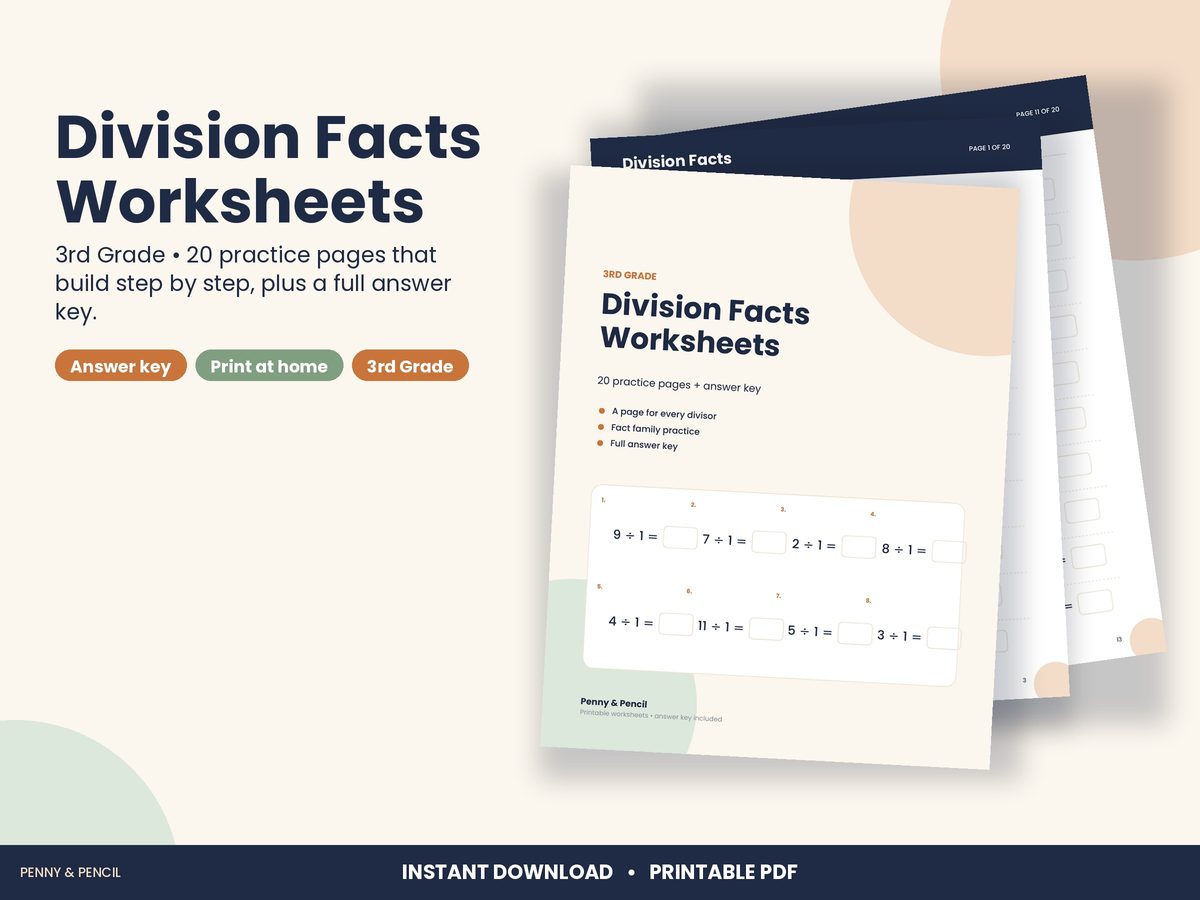
Start with sharing pictures, practise division facts with divisors 2–12, find missing factors, then try remainders and word problems. Choose the level the child can explain, using the worked examples below.
Get all five worksheets + answer keysDivision Facts Worksheets · The full paid pack has 20 practice pages: divisors 1–12, mixed division and fact families, with a matching answer key.
Buy Division Facts Worksheets on Etsy · $6.00Use pictures when equal groups are new, facts when the groups make sense, and missing factors to connect division with multiplication. Save leftovers for a separate lesson before mixing skills in stories.
Worked example: 12 ÷ 3 = 4. Sharing asks how many are in each of 3 equal groups; grouping asks how many groups of 3 can be made.
Each outlined group holds 4 dots, so sharing 12 among 3 gives 4 each. To group by threes instead, circle 3 dots at a time: you make 4 groups, with the same quotient but a different meaning for the 3.
Worked example: 56 ÷ 8 = 7. Think “8 times what makes 56?” Since 8 × 7 = 56, the quotient is 7; multiplication checks the answer.
The facts sheet has one problem per divisor from 2 to 12. Work untimed first and draw a model for an uncertain answer; all dividends here stay within 100. Treat the 11s–12s as optional extension practice, since the Grade 3 memorized-product target uses two one-digit numbers.
Worked example: 6 × □ = 42. Rewrite it as 42 ÷ 6 = □, then use 6 × 7 = 42 to fill the box with 7. The missing number counts how many sixes make the total.
On this sheet, every multiplication equation has a related division equation. Fill both blanks with the same whole number and check by multiplying.
Worked example: 17 ÷ 5 = 3 R2. Three groups of 5 use 15 objects, leaving 2; another full group would need 5. Check: 3 × 5 + 2 = 17, and 2 is smaller than the divisor.
The remainder sheet uses small totals so the leftover is the focus. For multi-digit dividends and written steps, continue with our long division worksheets.
Worked example: Put 24 crayons into boxes holding 6 crayons each. The unknown is the number of boxes: 24 ÷ 6 = 4, so you can fill 4 boxes; 4 × 6 checks the total.
Ask the child to name the total, the group size or number of groups, and what the answer measures. The four printable stories have exact answers; label each answer with its unit.
3.OA.A.2 covers both meanings of a whole-number quotient. The picture level supports that distinction; 3.OA.A.3 connects division within 100 to word problems.
3.OA.C.7 calls for fluent multiplication and division within 100. 3.OA.A.4 and 3.OA.B.6 connect unknown factors with division; the missing-factor sheet uses those relationships.
4.NBT.B.6 includes quotients and remainders with up to four-digit dividends and one-digit divisors. Our small-number remainder level is a bridge to that larger-number work.
These are Common Core reference points, checked 2026-11-18, rather than a rule that every child must start the same sheet at the same age.
Put the operations into stories with our word problems worksheets for grades 1–5, using a four-step method and printable answer keys.
The free download opens when you join our list: join below.
Join the Penny & Pencil list once, confirm the email we send, and every free download, printable and planner on this site opens. We send a welcome note, deals, and one email every two weeks. Unsubscribe any time.
You are in. Your free downloads are unlocked on this page.