Addition example
Ada has 7 shells and finds 5 more. How many shells does she have now?
Picture: Draw 7 dots and 5 more; circle the whole set.
Equation: 7 + 5 = 12. Answer: 12 shells.
Check: 12 − 5 = 7.
Choose word problems by grade and operation, then solve them in four steps: read, picture, equation, check. Start with addition and subtraction in grades 1–2; move to all four operations in grades 3–5 using the worked examples below.
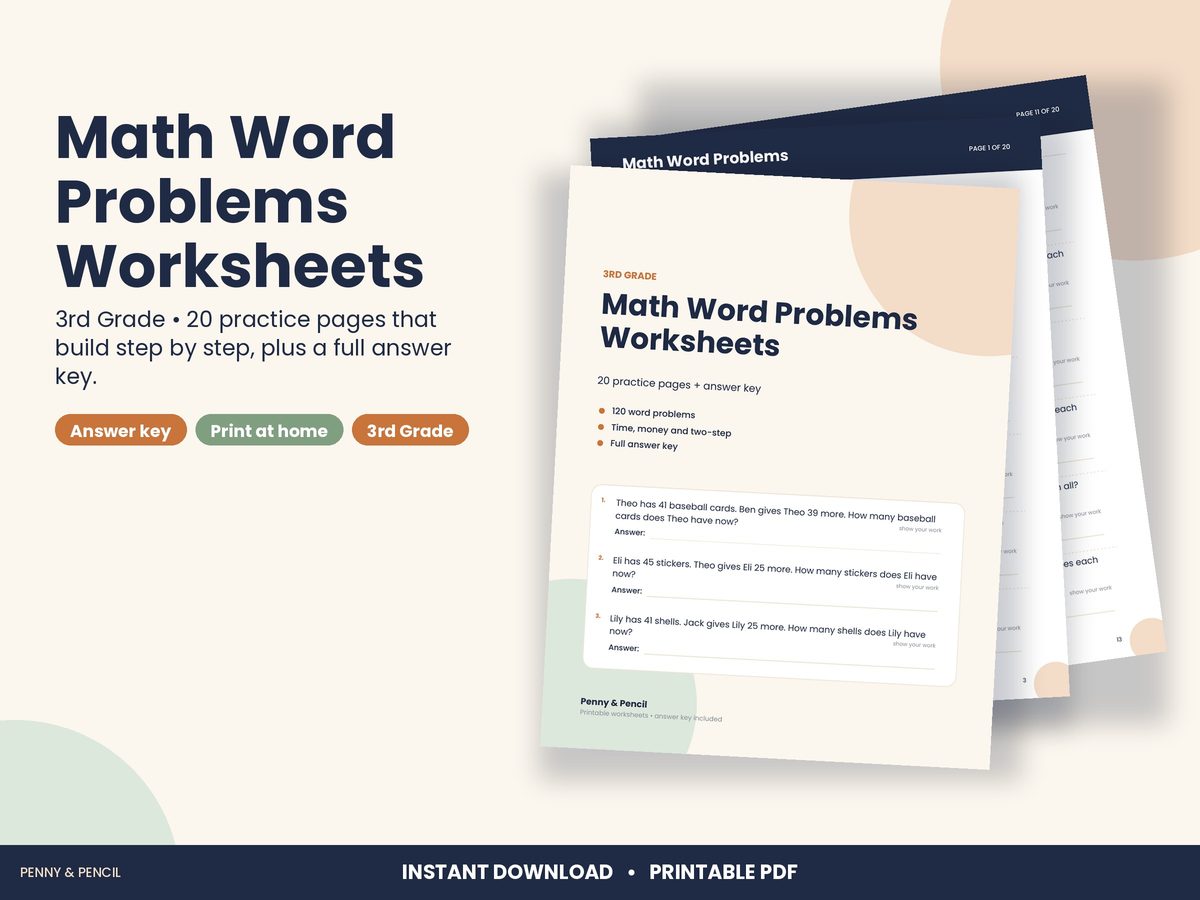
Get all five grade sets + answer keysMath Word Problems Worksheets · Want more third-grade practice? The paid pack has 20 practice pages plus a full answer key, covering operation stories and two-step problems.
Buy Math Word Problems Worksheets on Etsy · $6.00Choose the operation from the situation, rather than a single clue word: “more” can describe a comparison with a missing starting amount. For a two-step story, draw both changes before calculating.
Each sheet leaves room for a picture, equation, labelled answer and check; its key gives the calculation and reasoning. The examples on this page teach the method, while the downloads provide the complete practice sets.
Use addition and subtraction within 20, including missing parts and comparisons (1.OA.A.1). Formal multiplication and division are not targets in this set.
Ada has 7 shells and finds 5 more. How many shells does she have now?
Picture: Draw 7 dots and 5 more; circle the whole set.
Equation: 7 + 5 = 12. Answer: 12 shells.
Check: 12 − 5 = 7.
There are 16 birds on a fence. Then 6 fly away. How many birds remain?
Picture: Draw 16 marks and cross out 6.
Equation: 16 − 6 = 10. Answer: 10 birds.
Check: 10 + 6 = 16.
Use addition and subtraction within 100 for one- and two-step stories (2.OA.A.1). Equal arrays in 2.OA.C.4 are expressed with repeated addition; formal multiplication and division practice begins in the next set.
A class collects 28 leaves on Monday and 17 on Tuesday. How many leaves is that altogether?
Picture: Draw two bar parts labelled 28 and 17.
Equation: 28 + 17 = 45. Answer: 45 leaves.
Check: 45 − 17 = 28.
A library shelf has 63 books. Children borrow 25. How many books stay on the shelf?
Picture: Draw a bar of 63 and mark a removed part of 25.
Equation: 63 − 25 = 38. Answer: 38 books.
Check: 38 + 25 = 63.
Connect equal-group multiplication and division within 100 to stories (3.OA.A.3), then use all four operations in two-step whole-number problems (3.OA.D.8).
One team collects 26 cans and another collects 19. They need 50 cans. How many more cans are needed?
Picture: Join bars of 26 and 19, then compare with a target bar of 50.
Equation: 50 − (26 + 19) = 5. Answer: 5 more cans.
Check: 26 + 19 + 5 = 50.
There are 72 beads. Mia uses 18 and Sam uses 24. How many beads are left?
Picture: Partition 72 into used parts of 18 and 24 and a leftover part.
Equation: 72 − 18 − 24 = 30. Answer: 30 beads.
Check: 30 + 18 + 24 = 72.
Four trays hold 6 seedlings each. How many seedlings are there?
Picture: Draw 4 boxes with 6 dots in each.
Equation: 4 × 6 = 24. Answer: 24 seedlings.
Check: 24 ÷ 6 = 4.
Share 35 stickers equally among 5 children. How many stickers does each child get?
Picture: Draw 5 equal groups and distribute 35 dots.
Equation: 35 ÷ 5 = 7. Answer: 7 stickers per child.
Check: 7 × 5 = 35.
Distinguish “times as many” from “more than” (4.OA.A.2), and interpret remainders in multistep whole-number problems (4.OA.A.3).
A club has 125 craft sticks, receives 78 more, then uses 96. How many sticks remain?
Picture: Join 125 and 78, then mark 96 as the used part.
Equation: 125 + 78 − 96 = 107. Answer: 107 sticks.
Check: 107 + 96 − 78 = 125.
A hall has 240 seats. After 85 adults and 97 children sit down, how many seats are empty?
Picture: Split the total into adults, children and empty seats.
Equation: 240 − 85 − 97 = 58. Answer: 58 empty seats.
Check: 58 + 85 + 97 = 240.
A short ribbon is 18 cm long. A long ribbon is 4 times as long. What is the long ribbon length?
Picture: Draw 4 equal bar parts, each labelled 18 cm.
Equation: 4 × 18 = 72. Answer: 72 cm.
Check: 72 ÷ 4 = 18.
A class of 29 children travels in vans with 6 child seats each. How many vans are needed?
Picture: Draw 4 groups of 6 and one group of 5.
Equation: 29 ÷ 6 = 4 R5 → 5 vans. Answer: 5 vans.
Check: 4 × 6 + 5 = 29; 5 × 6 = 30 seats. Four vans seat only 24 children; the remaining 5 need another van, so round the van count up.
Write and interpret expressions with grouping symbols (5.OA.A.1–2). Decimal calculations here use 5.NBT.B.7, a separate domain; they are not described as a Grade 5 OA word-problem requirement.
A walking route is 1.25 km, followed by 0.75 km and then 2.50 km. How long is the route?
Picture: Join three bar segments labelled with their distances.
Equation: 1.25 + 0.75 + 2.50 = 4.5. Answer: 4.5 km.
Check: 4.50 − 2.50 − 0.75 = 1.25.
A jug holds 3.50 L. Pour out 1.25 L, then 0.80 L. How much liquid remains?
Picture: Partition a 3.50 L bar into two pours and a remainder.
Equation: 3.50 − 1.25 − 0.80 = 1.45. Answer: 1.45 L.
Check: 1.45 + 1.25 + 0.80 = 3.50.
Each of 3 bags holds 1.20 kg of oats and 0.30 kg of seeds. What is the total mass in the bags?
Picture: Draw 3 bags, each split into 1.20 kg and 0.30 kg parts.
Equation: 3 × (1.20 + 0.30) = 4.5. Answer: 4.5 kg.
Check: 4.50 ÷ 3 = 1.50; 1.20 + 0.30 = 1.50. The parentheses keep each bag’s two parts together before multiplying by the number of bags.
A 4.80 m cord is cut into pieces 0.60 m long. How many pieces can be cut?
Picture: Split a 4.80 m bar into equal 0.60 m parts.
Equation: 4.80 ÷ 0.60 = 8. Answer: 8 pieces.
Check: 8 × 0.60 = 4.80.
If a child can explain the story but needs fact practice, try our division worksheets by level or multiplication worksheets. For a focused third-grade starting point, see math word problems for third grade.
Objects that can be shared are different from vehicles that must carry everyone: a partly filled final van still counts as a whole van. Ask what the remainder means before writing the answer.
The free download opens when you join our list: join below.
Join the Penny & Pencil list once, confirm the email we send, and every free download, printable and planner on this site opens. We send a welcome note, deals, and one email every two weeks.
You are in. Your free downloads are unlocked on this page.