How to Calculate Net Worth: Total Assets and Subtract Debts
Calculate net worth on one date by adding recorded assets and subtracting recorded debts. Fictional example: assets of 24,000 dollars minus debts of 9,500 dollars gives net worth of 14,500 dollars.
The SEC’s Investor.gov defines net worth as assets minus liabilities. For this original recordkeeping example, all balances are fictional USD entries dated November 21, 2026, covering one person. Record the statement date and source beside each balance; flag an unavailable value rather than treating it as zero.
Fictional balances: November 21, 2026; USD
Entry
Asset
Debt
Checking
3,000
—
Savings
9,000
—
Car: entered value
12,000
—
Car loan
—
7,500
Credit card owed
—
2,000
Totals
24,000
9,500
Subtract total debts from total assets
The asset entries total 3,000 + 9,000 + 12,000 = 24,000. Debts total 7,500 + 2,000 = 9,500. The difference is 14,500 dollars. This is a balance snapshot, not monthly income or available spending money.
Avoid counting the same item twice
In the example, the car’s entered value is an asset and its outstanding loan is a separate debt. Do not enter a net-of-loan car amount and then subtract the loan again. Likewise, a transfer from checking to savings moves an existing asset; it does not create a second asset.
If a summary account includes several subaccounts, choose the summary or its components. For jointly owned entries, write the share and household scope used so a later snapshot is comparable. This guide does not choose values or recommend investments.
Keep negative results and missing values visible
A second fictional record with assets of 6,000 and debts of 8,500 gives −2,500. Preserve the minus sign; do not turn the result into zero. If a balance is missing, mark the statement incomplete and list what is absent before comparing totals.
Save the snapshot before the next update
Label the date, currency, person or household and balance sources.
Check asset and debt totals separately.
Keep assumptions and unresolved balances beside the calculation.
Retain the earlier record when entering a later date.
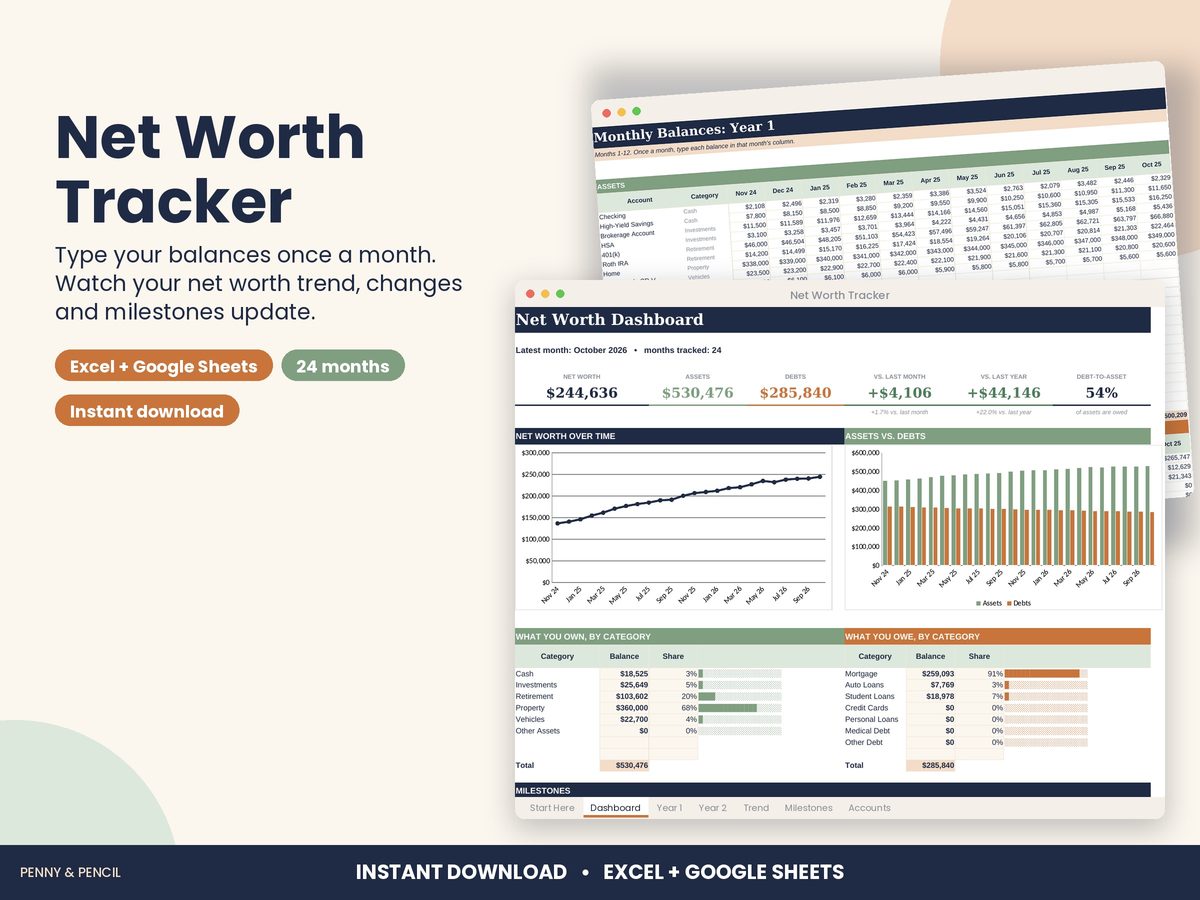
The Net Worth Tracker is an organizing spreadsheet for entered balances. The companion PDF is a separate printable record; neither this example nor a spreadsheet selects valuations for you.
Worked numbers, tables and teaching examples are original illustrations, not customer records.
The free download opens when you join our list: join below.
Free downloads unlock when you join our list
Join the Penny & Pencil list once, confirm the email we send, and every free download, printable and planner on this site opens. We send a welcome note, deals, and one email every two weeks.
You are in. Your free downloads are unlocked on this page.