What Are Sinking Funds? Plan an Irregular Expense with a Worked Example
A sinking fund is money you set aside in small, regular amounts for a cost you already know is coming, such as a yearly bill or a planned purchase. Fictional example: a 600-dollar car insurance renewal due in six months needs 600 ÷ 6 = 100 dollars set aside each month.
The CFPB describes an emergency fund as a cash reserve set aside for unplanned expenses or financial emergencies. A sinking fund is the opposite case: you can name the cost and roughly date it. Sorting each expense first keeps planned bills from draining money meant for surprises.
Fictional expenses sorted by whether the date is known
Expense
Date known?
Where it goes
Car insurance renewal
Yes, May
Sinking fund
Holiday gifts
Yes, December
Sinking fund
School fees
Yes, August
Sinking fund
Broken appliance
No
Emergency fund
Work out the monthly contribution
Use one formula for every fund: (target − amount already saved) ÷ number of contributions before the due date. This fictional record is dated November 22, 2026, with the first contribution in December.
Fictional sinking funds, first contribution December 2026
Fund
Target / saved
Contributions / monthly
Car insurance (May 2027)
600 / 0
6 / 100
Holiday gifts (Dec 2027)
480 / 0
12 / 40
School fees (Aug 2027)
240 / 60
9 / 20
Total each month
—
160
School fees show why the saved amount matters: (240 − 60) ÷ 9 = 20. The three contributions add to 100 + 40 + 20 = 160 dollars a month, which becomes one line in the monthly budget.
Handle an amount that does not divide evenly
A 500-dollar target over six contributions is 83.333… each. Record 83.33 for the first five months; 5 × 83.33 = 416.65, so the last contribution is 500 − 416.65 = 83.35. The fund then reaches the target exactly instead of finishing a few cents short.
Update the record when a cost changes
Suppose the insurance renewal notice arrives at 660 after two contributions of 100. The remaining gap is 660 − 200 = 460, spread over four contributions: 460 ÷ 4 = 115 a month. Write the new target, the date of the notice and the revised amount; do not overwrite the earlier contributions.
Check the record each month
Each fund has a target, a due month and a running saved total.
The saved totals match the balance you set aside for them.
A paid bill is recorded as spent from its fund, not as new spending.
Any change in a target recalculates only the contributions still to come.
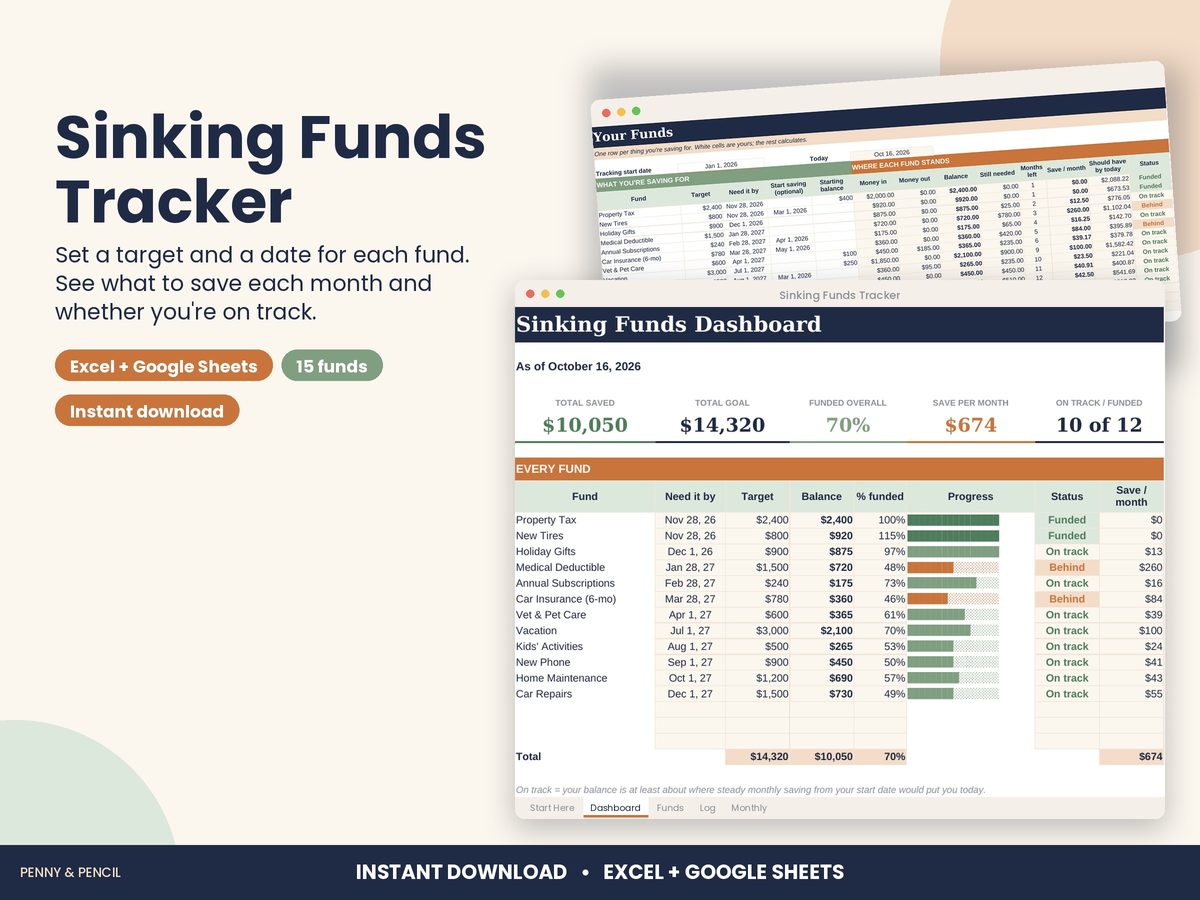
The Sinking Funds Tracker is a spreadsheet that totals the targets and contributions you enter; it does not connect to a bank or choose amounts for you.
Worked numbers, tables and teaching examples are original illustrations, not customer records.
The free download opens when you join our list: join below.
Free downloads unlock when you join our list
Join the Penny & Pencil list once, confirm the email we send, and every free download, printable and planner on this site opens. We send a welcome note, deals, and one email every two weeks.
You are in. Your free downloads are unlocked on this page.