Back-to-School Math Review: A First-Week Check and Practice Plan
For back-to-school math review, try a few already-taught questions, note whether each explanation was independent or helped, and choose one familiar skill to revisit. For example, a hint needed on 70 minus 26 points to reviewing the exchange, then checking 44 plus 26 equals 70.
Look at a recent assignment or teacher guidance and choose a small set of familiar skills. Ask for a drawing or explanation beside each answer. Omit an untaught idea; an omission is not an error. The examples below illustrate a selection, not a required grade-level set.
Original first-week checks: choose only familiar skills
Try
Worked check
Write 307 in expanded form.
300 + 0 + 7. The zero holds the tens place.
46 + 18
64: fourteen ones become one ten and four ones. Check 64 − 18 = 46.
70 − 26
44: exchange to six tens and ten ones. Check 44 + 26 = 70.
Draw 3 groups of 5.
15 objects. Check 15 ÷ 3 = 5 in each group.
Read the attempt, not a total score
Mark each attempted question “independent,” “with a hint” or “with a model.” If a child writes 70 − 26 = 56, ask what happened to the tens after the exchange. The corrected representation is six tens and ten ones, so ten minus six leaves four ones and six minus two leaves four tens.
Choose that exchange as the next practice target if it caused difficulty. A copied digit or unread direction calls for a different follow-up than an unexplained exchange. Keep the actual work so the observation has context.
Turn one observation into a back-to-school math review plan
Fictional first-week review log, not a score sheet
Day
Observation and next action
Monday
Expanded form and addition explained alone; subtraction needed an exchange hint; equal groups not yet taught, so omitted.
Tuesday
Revisit subtraction only: model 60 − 24 = 36, then invite an explanation.
Wednesday
Try 80 − 35 = 45 without the model. Check 45 + 35 = 80; note any hint used.
Thursday
If still unsure, keep the drawing and question for the teacher. Otherwise try one similar subtraction.
Friday
Record what was explained independently and choose one familiar skill for next week.
For Tuesday’s worked example, five tens and ten ones minus two tens and four ones leaves three tens and six ones; 36 + 24 = 60 confirms the result. The weekday plan is optional and can be shortened or paused.
Pencil’s first-week surprise: what does a blank answer tell you?
Ask whether the directions or skill are familiar before choosing practice. A blank alone does not identify a skill gap.
Select materials after choosing the review target
The math review packet guide helps compare a sample with the selected skill. The summer math routine offers a separate mixed-skill session for work already taught; this page uses first-week observations to decide what to revisit.
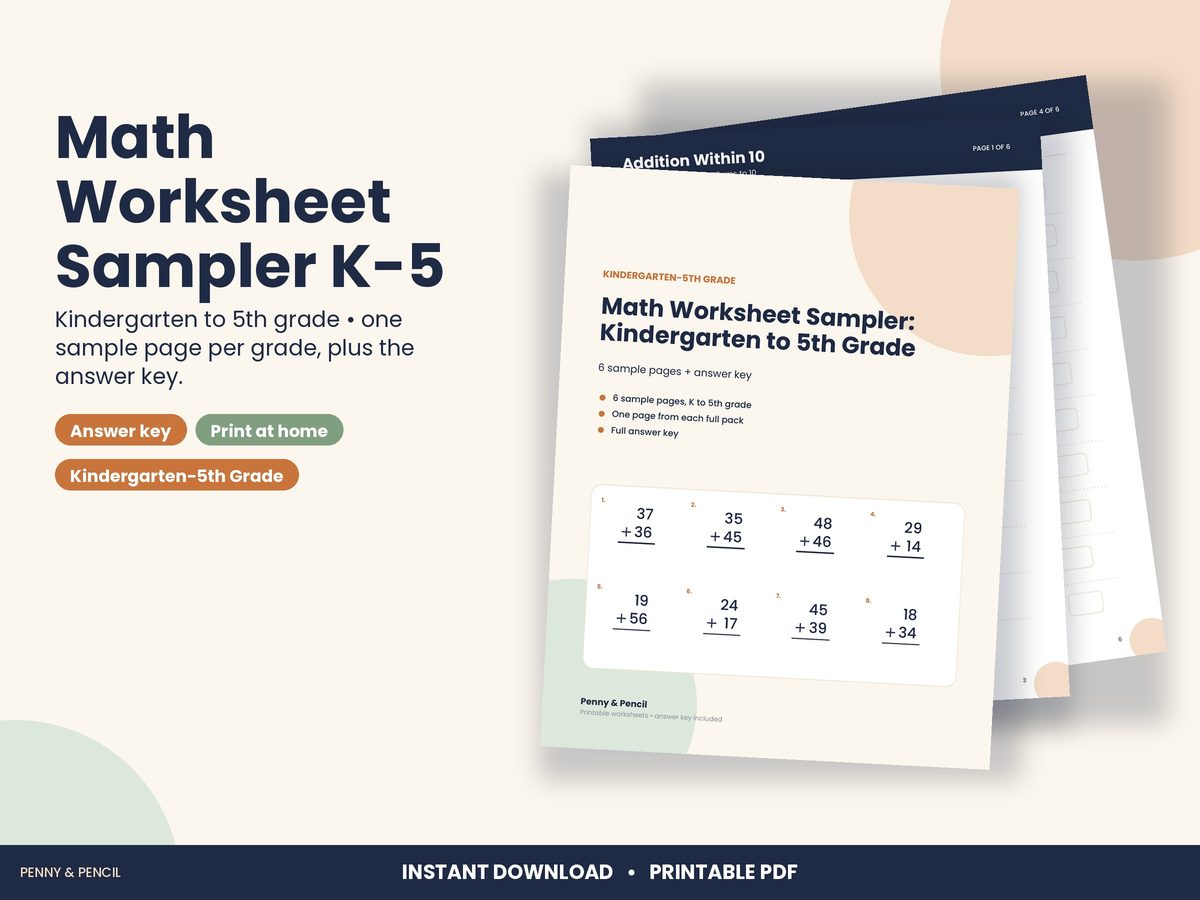
The Math Worksheet Sampler K-5 contains six practice pages, one per grade, plus a full answer key. Its grade labels help locate a page to inspect; it is not a graded assessment, placement test or new back-to-school product. The list-gated Thanksgiving addition sample is a separate file, not the paid sampler.
The procedures, questions and worked examples are original illustrative material.
The free download opens when you join our list: join below.
Free downloads unlock when you join our list
Join the Penny & Pencil list once, confirm the email we send, and every free download, printable and planner on this site opens. We send a welcome note, deals, and one email every two weeks.
You are in. Your free downloads are unlocked on this page.