For summer math practice, try a short routine: a place-value warm-up, two calculations, one story problem and an answer check. Use skills already taught, change the numbers to fit the learner and note one step to revisit next time.
Set out paper and a pencil, choose a comfortable number range and use the time boxes below as an example. Stop sooner if the learner needs a break; the schedule is a planning choice, not a required practice dose.
One optional ten-minute session, using skills already taught
Time
What to do
2 minutes
Read 245 aloud, then write its hundreds, tens and ones.
4 minutes
Solve 38 + 27 and 81 − 46. Show an exchange with a drawing if needed.
2 minutes
Solve the short story problem below and label the answer.
2 minutes
Check each result, revisit one error and note the next skill to try.
Mix place value, calculation and a story problem
Try the questions in the left column before checking the worked answers. These examples combine two-digit operations with a place-value warm-up; choose them only if those ideas have already been taught.
Original practice set with worked answer checks
Question
Answer and check
What does each digit in 245 mean?
2 hundreds, 4 tens, 5 ones: 200 + 40 + 5 = 245.
38 + 27
65. Eight ones plus seven ones make 15 ones; exchange ten for a ten. Check: 65 − 27 = 38.
81 − 46
35. Exchange one ten: seven tens and eleven ones. Check: 35 + 46 = 81.
A jar has 24 shells. Add 18, then give away 15. How many remain?
Pencil’s summer surprise: can you check the shells another way?
Draw 24 circles, add 18 more and cross out 15. Count what remains, then compare your picture with the two-step calculation.
Change the numbers without changing the routine
For a smaller-number session, read 16 as one ten and six ones, solve 8 + 5 and 13 − 5, then tell a story about 8 objects with 5 more arriving.
For a learner already working with equal groups, replace one calculation with 3 groups of 4. Draw three groups, count 12 objects and check 12 ÷ 3 = 4.
If the exchange is the sticking point, work on that one step together instead of adding harder operations.
These are choices for adapting a session, not grade placement or a curriculum sequence. The paid regrouping pack covers addition and subtraction; the equal-groups example is original guide content, not a claim about that pack.
Keep a tiny practice record for the next day
Write the date, questions tried, one method explained and whether help was needed. For example: “July 6 — place value independent; subtraction exchange with a drawing; next time try 72 − 38.” That next calculation is 34, checked by 34 + 38 = 72.
Repeat the routine with different numbers, or pause to model a step. Compare explanations across sessions rather than turning this short set into a speed test or a promised learning result.
Inspect a sample before choosing more pages
The email-list sample is the site’s existing Thanksgiving addition-with-regrouping worksheet and key. Its seasonal artwork stays as shown; it is a separate sample, not a new summer packet or the full paid pack.
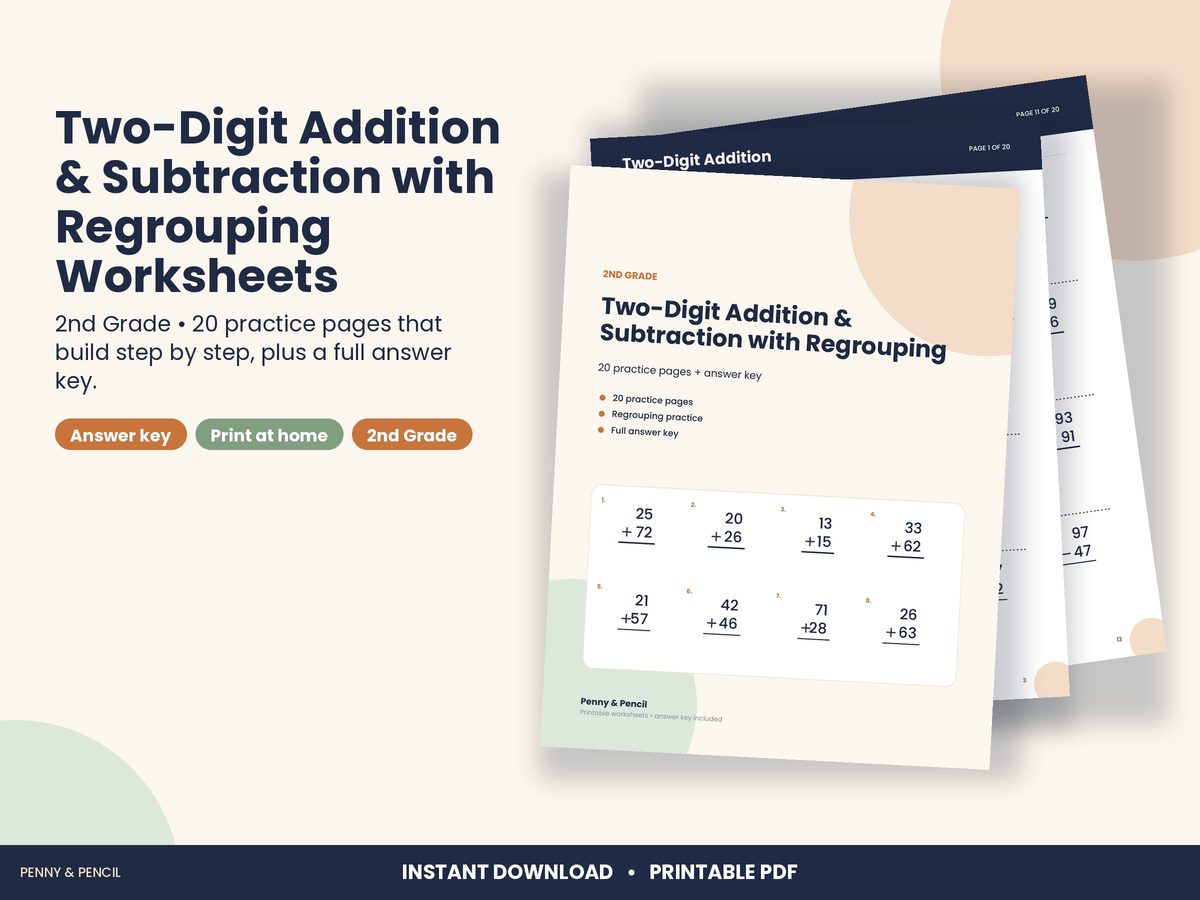
The Two-Digit Addition & Subtraction with Regrouping Worksheets pack contains 20 practice pages and matching answer keys, moving from no regrouping to carrying, borrowing and mixed practice. Use selected exercises for the calculation part of your own routine. The license covers personal use or one classroom.
The free download opens when you join our list: join below.
Free downloads unlock when you join our list
Join the Penny & Pencil list once, confirm the email we send, and every free download, printable and planner on this site opens. We send a welcome note, deals, and one email every two weeks.
You are in. Your free downloads are unlocked on this page.