Start with one clear job per person: write the name, chore and days, then tick a box when it is done. Use the age-group ideas below to choose tasks that fit your household.
The two-page printable has a seven-day family chart and an individual chart with space for an optional allowance agreement.
Free with the Penny & Pencil email list; confirm your email to unlock the printable.
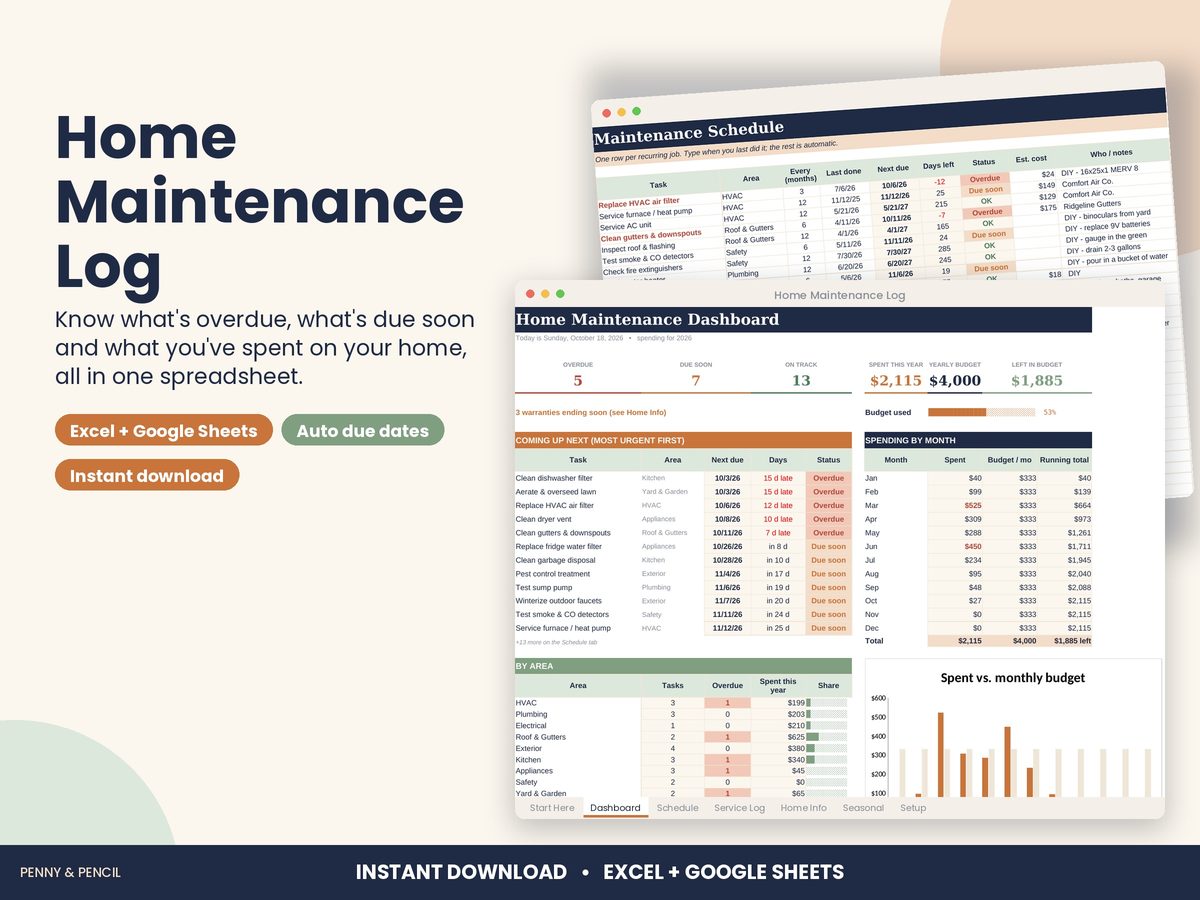
Home Maintenance Log tracks recurring home upkeep, repair costs and appliances in Excel and Google Sheets. It is a separate household maintenance tool.
These are suggested starting menus, not milestones or promises about what a child should do. Choose by the person’s experience, access needs and your home; an adult decides what is suitable and supervises as needed.
Pick one or two tasks to try this week
Age group
Chore options
Set it up
3–5
Put toys in a low basket; place napkins on the table; pair socks.
Do the job together; use light, unbreakable items.
6–8
Make the bed; put away folded clothes; clear their place after meals.
Show where each item belongs and agree on the finish.
9–12
Sweep a small room; sort laundry; unpack non-fragile groceries.
Choose a manageable area and check the result together.
Teens
Change bed linens; vacuum shared spaces; plan and prepare a simple cold lunch.
Agree on timing, equipment and a shared-space standard.
Keep chemicals, heat, sharp tools and climbing out of this chart. Leave out any task you cannot set up safely.
Weekly family chore chart example
This filled example shows how to divide a week. On the printable, each row has a person, a task and seven blank day boxes; mark unused days with a dash.
Person
Task
Days
When
Sam
Put toys in basket
Mon–Sun
After play
Alex
Clear own place
Mon–Sun
After dinner
Jordan
Sweep kitchen
Tue / Thu / Sat
After dishes
Adult
Check shared spaces
Mon–Sun
Before bedtime
How to set up your chore chart template
List the jobs your household actually needs; leave maintenance and repair work on a separate list.
Choose a small set together and give each row one owner, including adults.
Make the finish visible: “toys inside the basket” is easier to check than “tidy up.”
Write the days and timing, demonstrate unfamiliar jobs and keep supplies within reach where appropriate.
Put the chart where you review it; tick completed jobs together and leave blank space for changes.
Optional allowance: a worked example
An allowance is optional; you can use both charts without paying for chores. If your household chooses paid extra jobs, agree on the amount and what counts as finished before starting.
Three extra sorting jobs at 50 cents each = 150 cents.
Two extra sweeping jobs at 100 cents each = 200 cents.
In this example, saving 100 cents leaves 250 cents to assign elsewhere: 100 + 250 = 350. These are invented planning amounts, not an age-based payment recommendation.
A five-minute weekly review
Check each row together: done, skipped or no longer needed?
Ask which instruction or supply was missing and change that row.
Move a task to another day if the timing did not work.
If using allowance, total only the agreed completed extras and record the amount.
Write next week’s start date and choose any new jobs before resetting the chart.
Checked November 18, 2026. Chore menus, charts and allowance calculations are original Penny & Pencil planning examples; no child-development, grade-level or financial guidance claims are used.
The free download opens when you join our list: join below.
Free downloads unlock when you join our list
Join the Penny & Pencil list once, confirm the email we send, and every free download, printable and planner on this site opens. We send a welcome note, deals, and one email every two weeks. Unsubscribe any time.
You are in. Your free downloads are unlocked on this page.