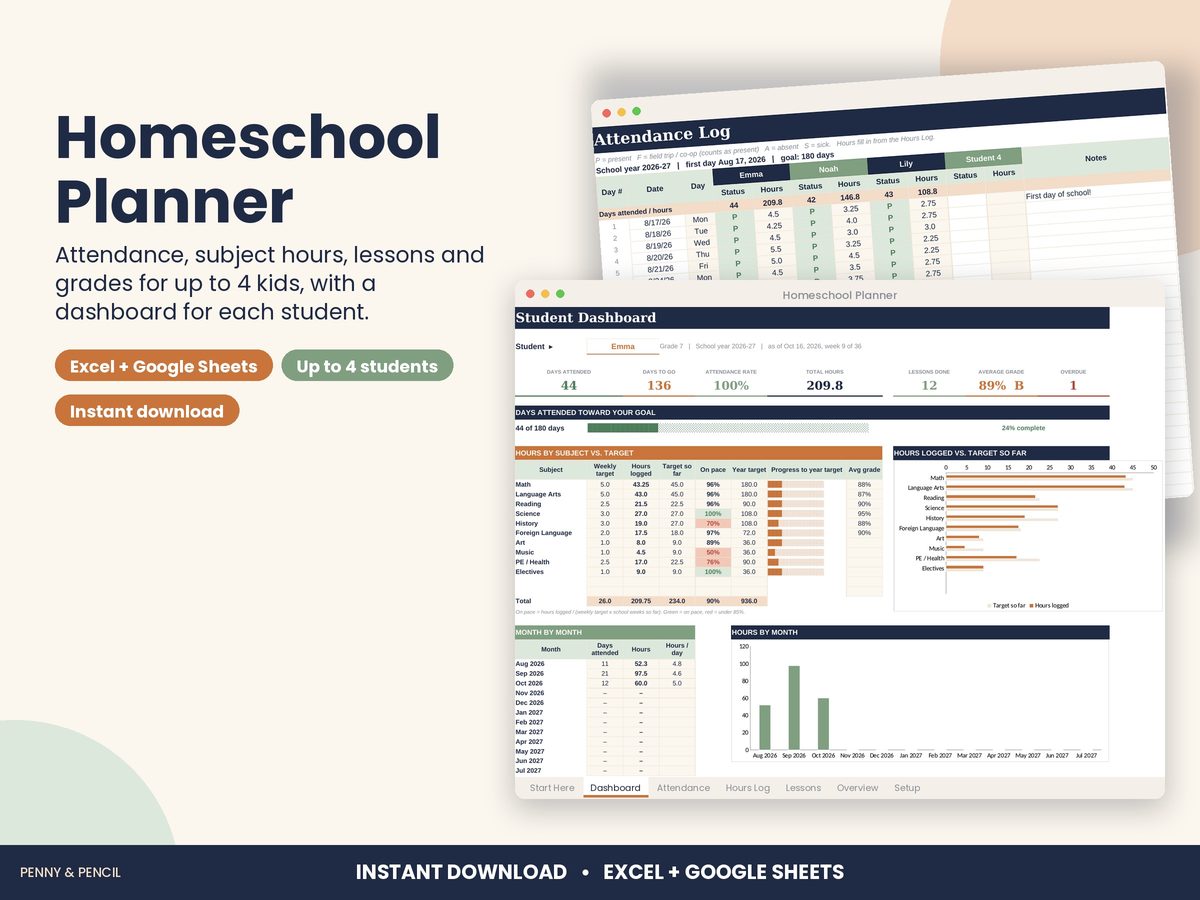
Plan the year’s school days, give each subject a weekly lesson, then record what actually happened each day. Start with the examples below and adjust them for your family.
Example year: 190 planned days − 10 days off = 180 attended.
Yearly homeschool plan: school days worked to a total
This sample allocates 190 possible teaching days across ten months. The dates are your choice; the numbers are a planning example, not a required calendar.
Month
Planned days
August
15
September
20
October
22
November
17
December
12
January
20
February
18
March
22
April
20
May
24
Total
190
The monthly sum is 15 + 20 + 22 + 17 + 12 + 20 + 18 + 22 + 20 + 24 = 190. If 6 days are missed for illness and 4 for other time off, 190 − 6 − 4 = 180 days attended. Count completed days in your log; a reserved day is not attendance.
Choose a start date, block out holidays, and leave room to move lessons. Compare the running total with your own target monthly so a shortfall is visible early.
Weekly lesson plan by subject
Example week for one learner: these activities illustrate a planning method, with no grade-level alignment claimed. Replace each task with your curriculum’s next lesson and record the book or page beside it.
Subject
Monday
Tuesday
Wednesday
Thursday
Friday
Reading & writing
Read chapter 1; retell
Read chapter 2; new words
Write a paragraph
Revise with feedback
Read aloud; save work
Math
Model equal groups
Draw arrays
Practise facts
Solve story problems
Review missed problems
Science
Ask a plant question
Plant two seeds
Observe and sketch
Measure growth
Record findings
History & geography
Choose a local place
Locate it on a map
Read its history
Make a timeline
Tell what changed
Art, music & movement
Draw outdoors
Sing and clap rhythms
Walk and observe
Paint a scene
Play a movement game
For the math row, choose a suitable skill from our multiplication worksheets. Carry unfinished work forward after reviewing what needs more time.
Daily homeschool schedule sample
This morning routine is an example, not an instructional-hours target or a complete required school day. Add afternoon work, breaks and other subjects to suit your learner and local requirements.
Time
Activity
9:00–9:20
Read aloud and talk
9:20–9:50
Math lesson and practice
9:50–10:10
Snack and movement
10:10–10:40
Reading and writing
10:40–11:10
Science or history
11:10–11:30
Art, music or outdoor activity
11:30–11:40
Review work and update the log
Attendance and record-keeping log
Use one row per student per date. Record attendance separately from planned lessons; if you track subject time, enter actual minutes without counting overlapping activities twice.
Date
Student
Attendance
Learning / record
Running days
Aug 17
Sam
Present
Reading; arrays; seed sketch A01
1
Aug 18
Sam
Absent
Illness; reschedule lessons
1
Aug 19
Sam
Present
Writing; maths; photo A02
2
The example has two attended days across three dates. Keep a separate subject-time record when needed; the running-day column alone does not show hours.
Monthly records checklist
Compare planned days with the dates actually attended for each child.
File dated work samples with a simple reference such as A01 so the log points to the right piece.
Keep a list of books, curriculum and completed assignments beside assessment notes.
Back up the log and mark the next review date on your calendar.
Check your state’s current instructions for any notices, testing, evaluations or records you need.
Check your own state before setting a target
For one state example, Pennsylvania’s Department of Education guide gives home education attendance options of 180 days, or 900 hours at elementary level, or 990 hours at secondary level; both days and hours are not required. See the guide’s “Truancy” section, printed page 55, checked November 18, 2026.
Check your own state education department’s current homeschool guidance before choosing a calendar or record format. This planner is an organizational tool, not legal advice or proof that a program meets requirements.
Printable planner: what is included
The download has a blank yearly day-count plan, a weekly subject grid, a daily routine page and a 20-row attendance log with room for work-sample references. Reuse the weekly and log pages as needed; the printable does not calculate totals.
The free download opens when you join our list: join below.
Free downloads unlock when you join our list
Join the Penny & Pencil list once, confirm the email we send, and every free download, printable and planner on this site opens. We send a welcome note, deals, and one email every two weeks. Unsubscribe any time.
You are in. Your free downloads are unlocked on this page.