How Much Allowance Should Kids Get? A Family-Funded Example
Choose an allowance from your family’s own available funds, covered purchases and payment frequency. Fictional example: 48 dollars set aside for two children over four weekly payments gives 6 dollars per child per week. This is arithmetic for a chosen family plan, not a recommended universal rate.
Write which optional purchases the allowance covers, which costs adults continue to pay and how often payment happens. A family might include small optional treats while adults cover school supplies. That is a fictional household choice, not a rule for other families.
Use your household’s own available funds after its recorded plans. If there is no amount available, keep that visible rather than using a national average or an age-based rate to fill the gap. This page supplies no universal recommended allowance.
Work backwards from a family-funded total
Fictional family example: USD, four weekly payments this period
Family record
Amount or calculation
Available for allowance after the family’s other recorded plans
48 dollars for this four-payment period
Children included in this example
2; the family chooses equal amounts
Amount per child for the period
48 ÷ 2 = 24 dollars
Weekly amount per child
24 ÷ 4 = 6 dollars
Total check
2 × 4 × 6 = 48 dollars
All allowance figures here are invented arithmetic examples, not surveyed costs, typical rates or financial advice. Replace the period total, number of children and payment count with your own entries. Equal amounts are this example’s choice; record any different family arrangement explicitly.
Count paydays rather than assuming every month has four
If the same fictional family schedules five weekly payments at 6 dollars for each of two children, the period needs 60 dollars: 2 × 5 × 6. That is 12 more than its original available total. Record the mismatch before confirming the schedule.
To illustrate a recalculation rather than recommend a cut, keeping the original 48-dollar total across ten child-payments would give 4.80 each. The family must decide its arrangement; a worksheet only shows what its entries require. Do not label an unpaid future allowance as money already received.
Keep base allowance and paid chores distinct
Write whether ordinary chores affect the allowance, whether extra jobs have separate agreed pay and when the arrangement will be reviewed. If a fictional child receives 6 base plus 2 for an agreed extra job, record 8 received once. Record any split into jars as an allocation of that same money, not a second payment.
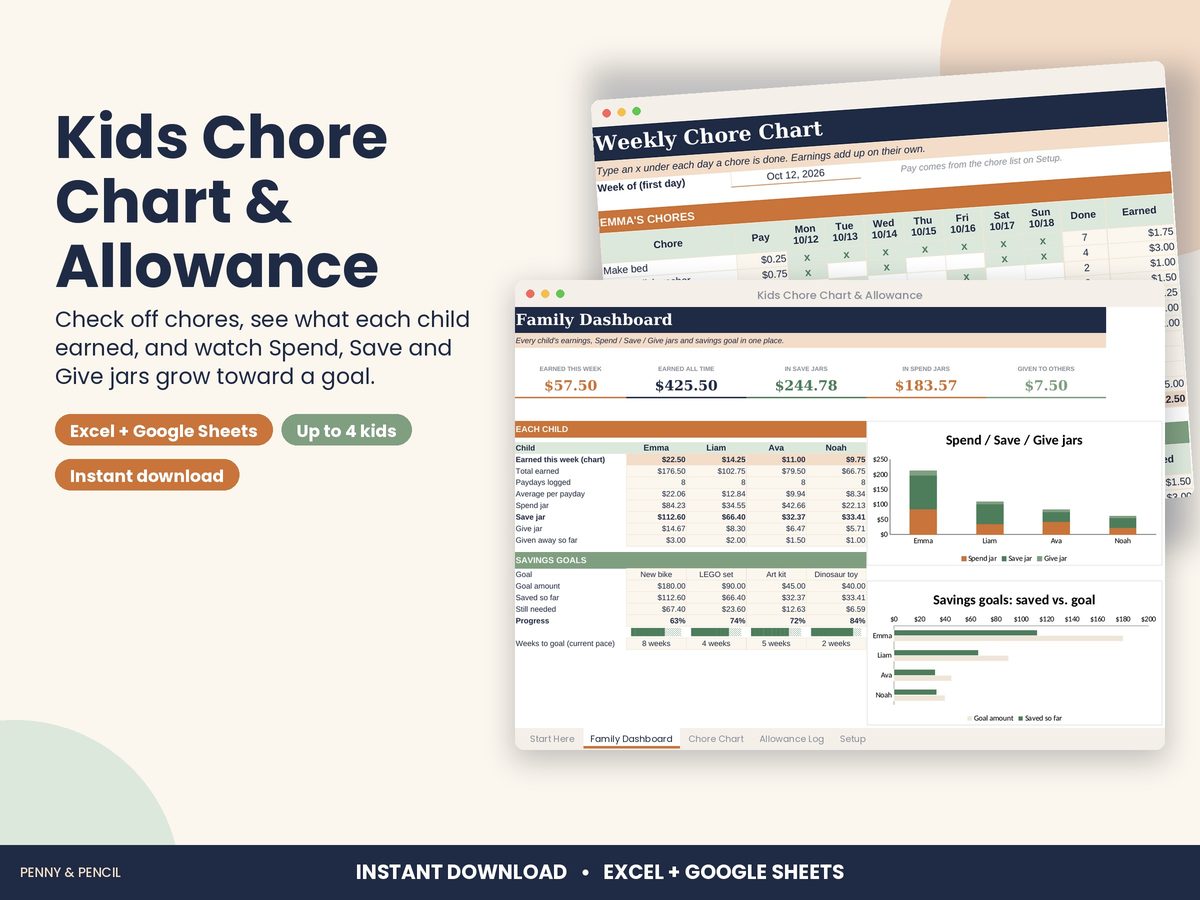
The Kids Chore Chart & Allowance tracker totals user-entered rates and base allowance. It supports up to four kids and Spend, Save and Give splits chosen by the family. Each week, copy the chart’s weekly total into the log to preserve history; the product does not select an affordable allowance for you.
Review the record at an agreed date
Record the payment date, planned amount, actual amount and purchases the child is expected to cover.
Compare the period’s allowance total with the household amount originally set aside.
When the family changes the arrangement, note the new amount and start date rather than rewriting earlier receipts.
The gated chore-chart PDF is a blank companion for jobs and days, not the paid workbook or an allowance-rate calculator. For the wider household record, see the household budget spreadsheet guide and money templates.
The procedures, questions and worked examples are original illustrative material.
The free download opens when you join our list: join below.
Free downloads unlock when you join our list
Join the Penny & Pencil list once, confirm the email we send, and every free download, printable and planner on this site opens. We send a welcome note, deals, and one email every two weeks.
You are in. Your free downloads are unlocked on this page.