Carry an unspent category balance into next month as its opening allocation. Add the new allocation, subtract spending, and keep the carried amount out of new income.
Keep a separate category ledger with month, category, opening allocation, new allocation, spending and ending allocation. Calculate ending = opening + new − spent. Move that ending figure to the next month’s opening column.
“New allocation” means money assigned to the category this month. It is a planning entry, not another income transaction. Record pay only when received; do not enter a category carry-forward in the income log.
Two months without duplicated income
Fictional example: November starts with no money allocated to these two categories. The household assigns $500 in each month. These are only two categories of a larger budget.
Groceries
Groceries allocation ledger — fictional inputs
Month
Opening
New
Spent
Ending
November
$0
$400
$350
$50
December
$50
$400
$420
$30
Home supplies
Home supplies allocation ledger — fictional inputs
Month
Opening
New
Spent
Ending
November
$0
$100
$40
$60
December
$60
$100
$90
$70
November ends with $110 allocated but unspent: $50 for groceries and $60 for home supplies. December starts with those same allocations, adds $500 and records $510 spent, leaving $100.
Across both months: $1,000 newly allocated − $900 spent = $100 left. Adding the $110 carry-forward to new income would count the same money again.
Category allocation is different from a bank balance
A category balance records the purpose assigned to money. A bank balance records money in that account. These two categories do not describe all the household’s cash, other allocations or pending payments.
Moving $50 between your own accounts does not create $50 of income or increase a category’s allocation. Reconcile accounts separately using the multiple-account budget and transfer example.
Month-end carry-forward checklist
Finish recording the month’s purchases once, under the correct categories.
Calculate each ending allocation and check the arithmetic against its opening, additions and spending.
Copy the ending amount to next month’s opening allocation; leave the new-income total unchanged.
Record new allocations separately. A change of purpose between categories needs an equal decrease and increase, with a note.
Investigate a negative result. For example, $20 opening + $80 new − $120 spent leaves −$20; do not silently reset it to zero. Record any reallocation explicitly.
Use a separate ledger beside your planner
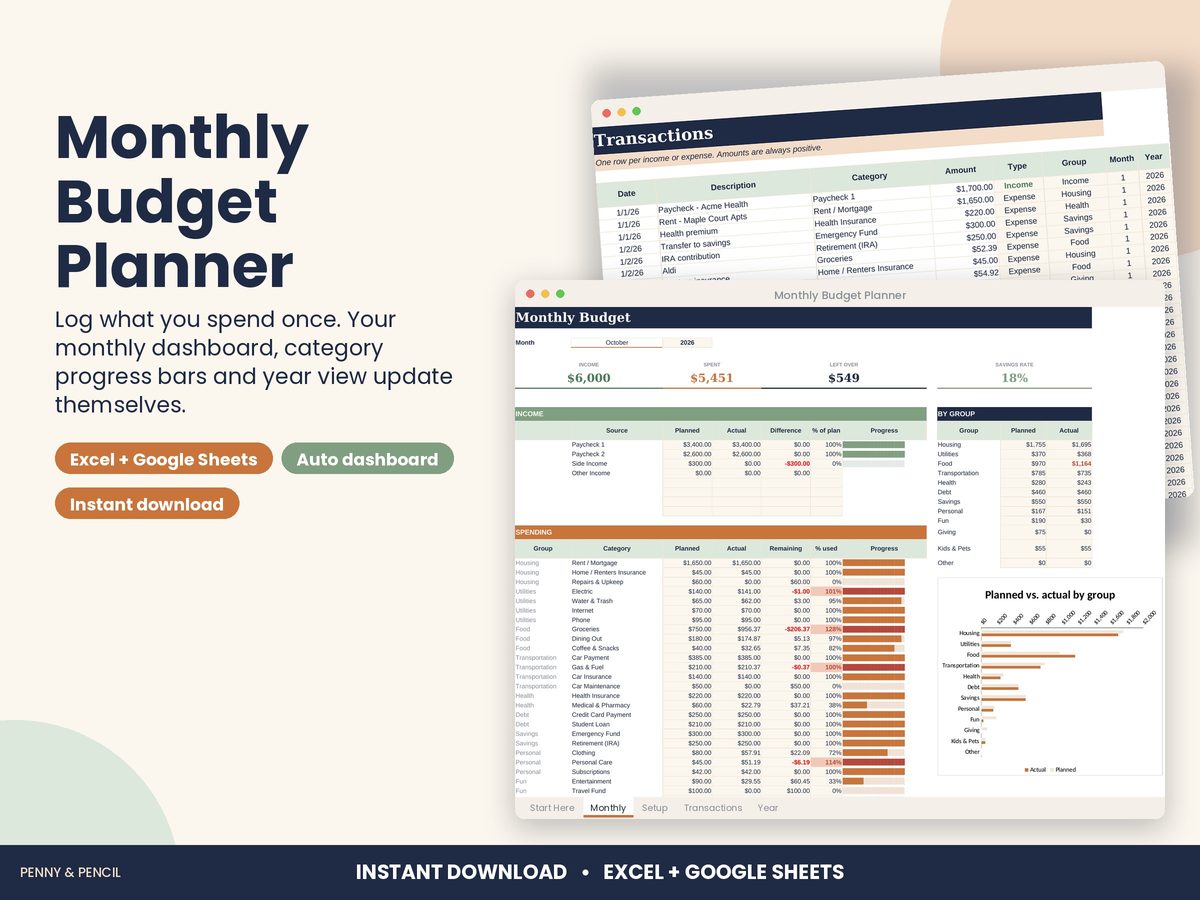
The Monthly Budget Planner provides a transaction log and category records. The carry-forward ledger above is an editorial example for manual bookkeeping beside it; the sold workbook is not claimed to roll categories forward automatically.
The email-list sample linked above is the existing one-page monthly budget sheet. It has planned, actual and difference columns; it is not a rollover workbook. Keep the extra opening and new-allocation columns in your own separate ledger.
The two-month ledger and all figures are original fictional recordkeeping examples, not financial, tax or legal advice.
The free download opens when you join our list: join below.
Free downloads unlock when you join our list
Join the Penny & Pencil list once, confirm the email we send, and every free download, printable and planner on this site opens. We send a welcome note, deals, and one email every two weeks.
You are in. Your free downloads are unlocked on this page.