Why transfers inflate a combined budget
If you mark the $500 leaving checking as spending and the same $500 arriving in savings as income, both totals rise even though no outside income or purchase occurred. A card payment also repeats spending if you already recorded the card purchases.
For this example, track income and purchases across all three accounts. Savings allocations belong in a separate planning subtotal; they are not purchases in this combined spending report. A cash-only payment budget uses a different view, so do not mix the two methods.
Worked month: checking, savings and a credit card
Fictional household with no interest, fees, refunds or pending transactions. The card starts at zero; a positive change increases the amount owed, while a negative change reduces it.
T1 pairs the savings move and T2 pairs the card payment. Keep both sides in the account ledger so each balance can reconcile, but exclude all four transfer rows from combined income and spending totals.
Checking: opening $1,000, closing $2,000
Checking statement movements| Entry | Change | Budget type |
|---|
| Pay received | +$3,200 | Income |
|---|
| Rent | −$1,200 | Expense |
|---|
| Groceries by debit | −$200 | Expense |
|---|
| Move to savings · T1 | −$500 | Transfer · exclude |
|---|
| Card payment · T2 | −$300 | Transfer · exclude |
|---|
Savings: opening $2,000, closing $2,500
Savings statement movements| Entry | Change | Budget type |
|---|
| From checking · T1 | +$500 | Transfer · exclude |
|---|
Credit card owed: opening $0, closing $0
Credit card owed statement movements| Entry | Change | Budget type |
|---|
| Groceries by card | +$200 | Expense |
|---|
| Transport by card | +$100 | Expense |
|---|
| From checking · T2 | −$300 | Transfer · exclude |
|---|
Combined budget totals: count outside income and purchases once| Record | Included amount |
|---|
| Pay received | $3,200 income |
|---|
| Rent from checking | $1,200 spending |
|---|
| Debit groceries | $200 spending |
|---|
| Card groceries | $200 spending |
|---|
| Card transport | $100 spending |
|---|
| Total purchases / expenses | $1,700 spending |
|---|
| T1 savings move: both sides | $0 income / spending |
|---|
| T2 card payment: both sides | $0 new spending |
|---|
The household has $1,500 more after recorded spending: $3,200 − $1,700. Checking plus savings minus card owed rises from $3,000 to $4,500, the same difference.
The savings plan can separately show $500 reserved and $1,000 still unassigned. That allocation does not change the $1,700 spent. If a card begins with an old balance, track its repayment in a separate cash-flow or debt allocation; it is not a new purchase in this month’s spending report.
Column layout for multiple accounts
Use date, account nickname, description, signed movement, type, spending category, transfer ID and cleared status. Include the account name on every row so equal amounts do not look like duplicates.
Calculate income only from rows typed Income, and spending only from rows typed Expense. Filter Transfer rows out of both summaries; a transfer’s paired rows remain in each account’s running balance. With a positive-owed card convention, its payment and checking withdrawal are both negative movements, so match the transfer ID and amount rather than expecting their signs to cancel.
Month-end reconciliation checklist
- Use the same month-end date for all statements; record opening balances before adding transactions.
- Match each cleared row to its statement once. Put pending items on a separate list.
- Pair each transfer ID with its source and destination; investigate missing sides before finalizing.
- Check opening balance plus movements equals the closing statement balance for each account.
- Review card purchases separately from payments; include fees or interest as their own expenses if present.
- Compare combined income minus spending with the change in checking plus savings minus card owed.
Printable transfer and reconciliation worksheet
The email-list PDF includes an account-balance table, transfer-pair record, separate budget totals and the reconciliation checks. Use nicknames, never full account numbers.
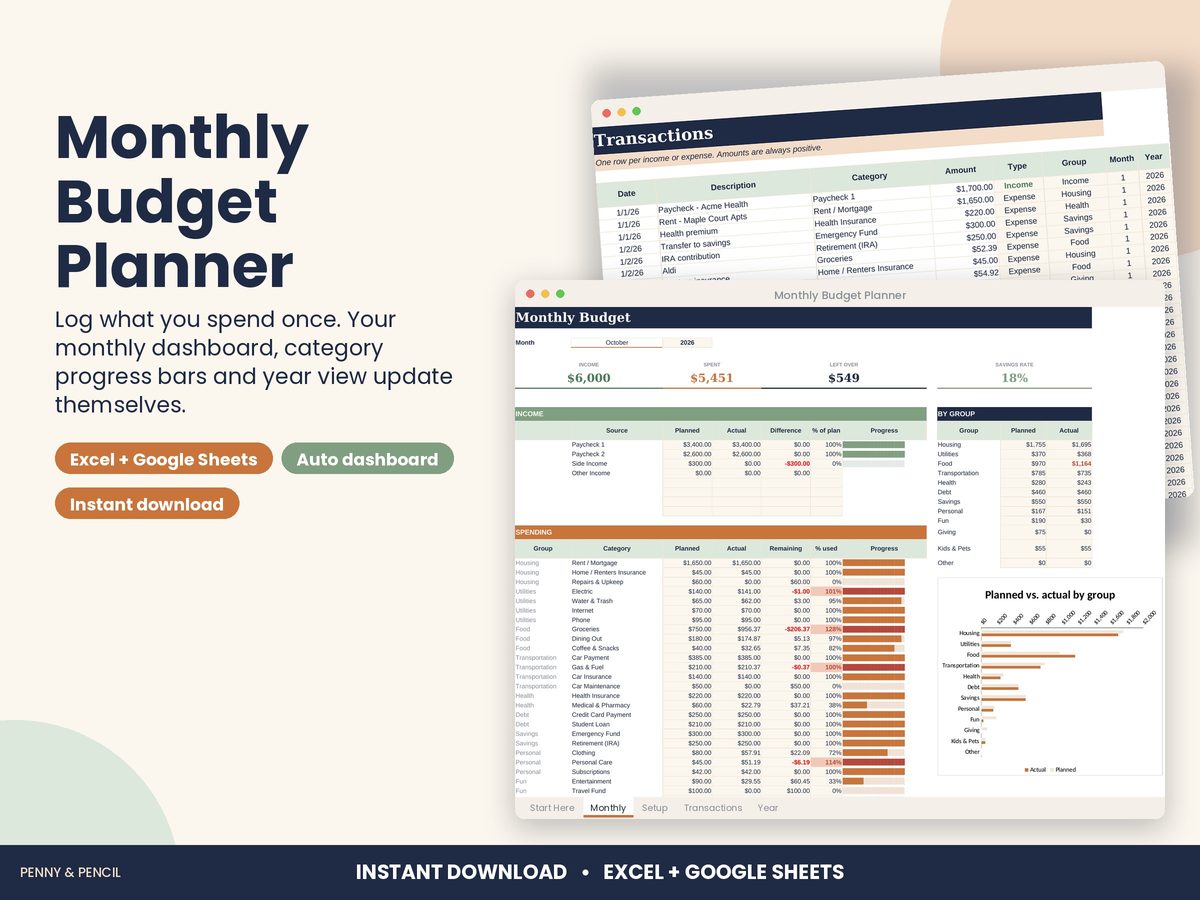
The Monthly Budget Planner’s live page describes a transaction log and monthly dashboard. The account and transfer columns here are a layout for your own records; no bank connection, account import or automatic reconciliation is implied.
For the category plan around these totals, see the monthly budget template.
Sources — read November 19, 2026
The transfer classification and three-account ledger are our own recordkeeping example. The CFPB cash-flow worksheet uses a different outflow view that includes savings allocations.