Kindergarten: Meet the coins
Name pennies, nickels, dimes and quarters; count pennies one at a time.
Worked example: You have 4 pennies. How many cents is that?
1 + 1 + 1 + 1 = 4 cents. Check: four coins worth one cent each make 4 cents.
Start money practice with coin names and pennies, then mixed coins, change from a dollar, adding prices and simple word problems. Choose a K–4 sheet below and try its worked example first.
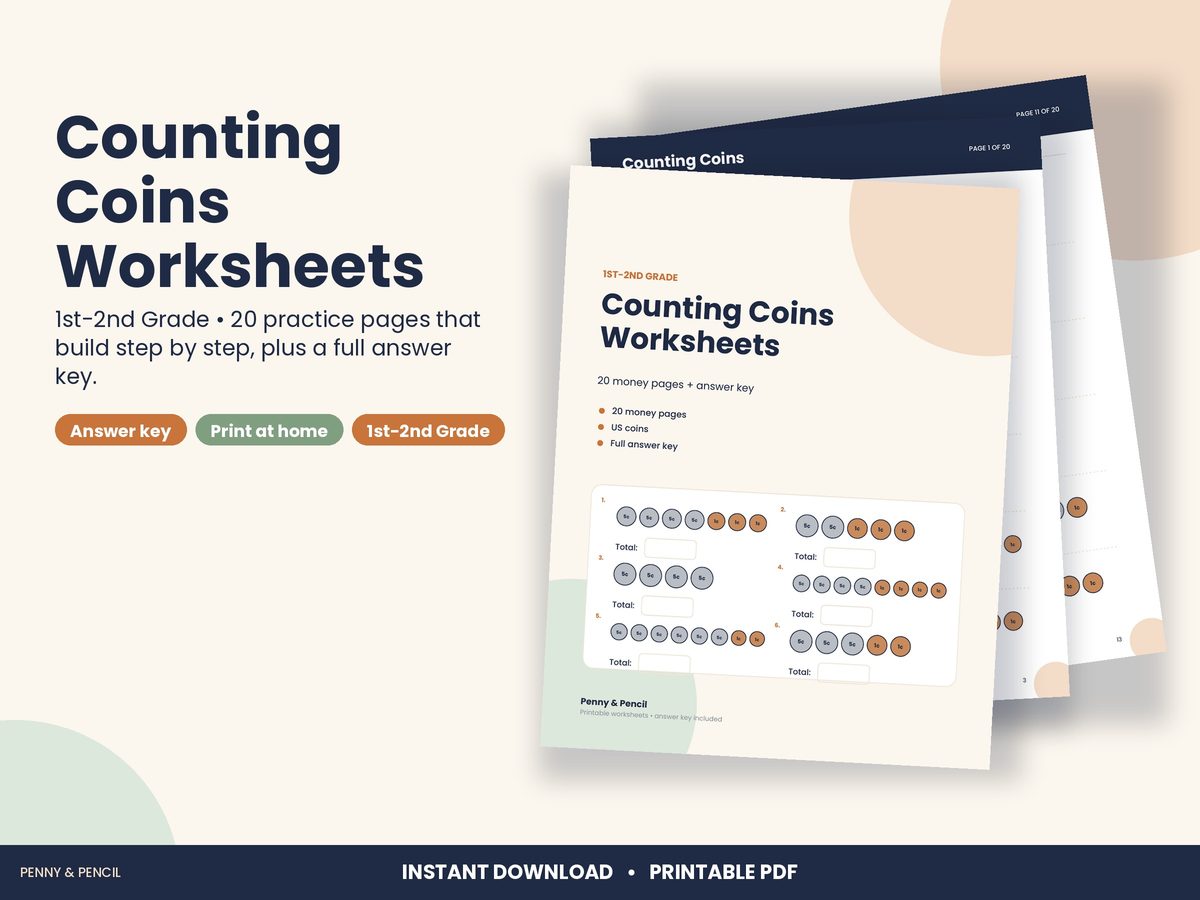
Get the free K–4 money worksheets (PDF)More counting practice? Counting Coins Worksheets has 20 practice pages for 1st–2nd grade and a full answer key, building from pennies and nickels to mixed coins up to $1.50.
Buy Counting Coins Worksheets on Etsy · $5.50Choose the skill your child is ready for. Each sheet has six questions and space to work; the final PDF page checks all 30 answers. All shop amounts are pretend practice amounts, with no tax added.
Name pennies, nickels, dimes and quarters; count pennies one at a time.
Worked example: You have 4 pennies. How many cents is that?
1 + 1 + 1 + 1 = 4 cents. Check: four coins worth one cent each make 4 cents.
Skip count by 5s and 10s, then add pennies to a running total.
Worked example: Count 2 dimes, 1 nickel and 3 pennies.
10 + 10 + 5 + 1 + 1 + 1 = 28 cents. Check: 20 + 5 + 3 = 28 cents.
Count mixed coins and count up from a whole-cent price to a one-dollar bill.
Worked example: A pencil costs 65 cents. You pay with a one-dollar bill. What is the change?
Count up: 65 to 75 is 10 cents; 75 to 100 is 25 cents. Change is 35 cents. Check: 65 + 35 = 100.
Add dollars and cents, line up decimal points, and find change from a five-dollar bill.
Worked example: A notebook costs $2.35 and an eraser costs $1.40. What is the total and the change from $5?
$2.35 + $1.40 = $3.75; $5.00 - $3.75 = $1.25 change. Check: $3.75 + $1.25 = $5.00.
Multiply a price by a quantity, add another item, and check the remaining money.
Worked example: Buy 3 folders at $1.25 each and a $2.40 notebook. How much is left from $10?
3 x $1.25 = $3.75; $3.75 + $2.40 = $6.15; $10.00 - $6.15 = $3.85 left. Check: $6.15 + $3.85 = $10.00.
A penny is 1 cent, a nickel 5 cents, a dime 10 cents and a quarter 25 cents. One dollar equals 100 cents. These sheets use those four coins and one-, five- and ten-dollar bills; bill values are printed on the notes. A bigger coin is not always worth more: a dime is smaller than a nickel.
Supervise young children with small coins and keep them away from mouths. If a mixed pile is frustrating, return to one coin type before adding another.
For more equal-group practice after counting coins, explore our multiplication worksheets.
Official educational sources read November 17, 2026: coin and bill values, plus sorting and combining coins. Grade suggestions and worked problems are Penny & Pencil practice examples.
Practise reading clocks by level with our telling time worksheets, from whole hours to elapsed minutes.
Explore parts and wholes with our number bonds worksheets, including missing parts and fact families.
Build the number sequence first with our counting worksheets: objects to 20, counting on, and ones and tens to 100.
Practise counting up from a cost to the amount paid with our making change worksheets, with US coin and bill examples.
Teach kids about money with a fixed pretend budget.
The free download opens when you join our list: join below.
Join the Penny & Pencil list once, confirm the email we send, and every free download, printable and planner on this site opens. We send a welcome note, deals, and one email every two weeks. Unsubscribe any time.
You are in. Your free downloads are unlocked on this page.