Teach Kids About Money: A Spend, Save and Give Choice Lesson
To teach kids about money, use ten pretend tokens and compare choices under that fixed total. A fictional split of 4 to spend, 5 to save and 1 to give totals 10. Choosing a 6-token purchase instead leaves less for the other purposes; ask the child to explain the tradeoff.
Set up a money lesson for kids with a fixed pretend budget
Put ten paper tokens on the table and label three spaces Spend, Save and Give. Each token stands for one pretend dollar. Draw a toy marked 6 and an activity marked 4; write a separate savings goal of 5. These are fictional lesson amounts, not real prices or recommended family percentages.
Explain the choices before moving tokens: spending exchanges tokens for an item now; saving keeps tokens toward a chosen later goal; giving sets some aside for a purpose the family chooses. Ask the child what matters to them in this exercise. A family can adapt the labels and giving purpose to its own values.
Compare a worked tradeoff under the same total
Fictional lesson: ten pretend one-dollar tokens, no extra income
Choice
Spend / save / give
A: buy the 6-token toy now
6 / 3 / 1 = 10; a 5-token savings goal still needs 2.
B: choose the 4-token activity
4 / 5 / 1 = 10; the same goal is fully allocated.
C: keep more for the family’s chosen giving activity
4 / 3 / 3 = 10; the savings goal still needs 2.
Choice A leaves the child with the larger purchase now and an unfinished goal. Choice B uses fewer tokens now so the goal can hold five. Choice C keeps the smaller purchase and moves two tokens from the goal to the chosen giving purpose. None is presented as the right family value.
Move the tokens, then check the record
Invite the child to choose a row or create another split whose three amounts total ten.
Have them physically move the tokens before writing the three balances.
For Choice B, spending four leaves six held: five for the goal and one for giving. After giving one, five remain.
Ask them to rebuild the original total: 4 spent + 1 given + 5 still held = 10 received.
Do not count the same five saved tokens as both available spending money and an additional receipt. If the child later spends them on the goal, record the withdrawal and purchase so the held balance changes once.
Ask what changed when the choice changed
Penny’s choice question: can Choice A reach the goal without new tokens?
Move two of the six spending tokens into saving. The split becomes 4, 5 and 1, so the 6-token toy no longer fits. The lesson is the tradeoff inside a fixed total, not a promise that money grows.
Invite a reflection: “What did you choose now? What did you leave for later? What would you change next round?” Start a new round with the same ten tokens and record it separately rather than adding both rounds as real income.
Connect the pretend record to the tools you already use
For coin values and change, use the separate money worksheets guide. Browse the money templates for household records. Choosing an allowance amount is a different family decision; no age-based rate is prescribed here.
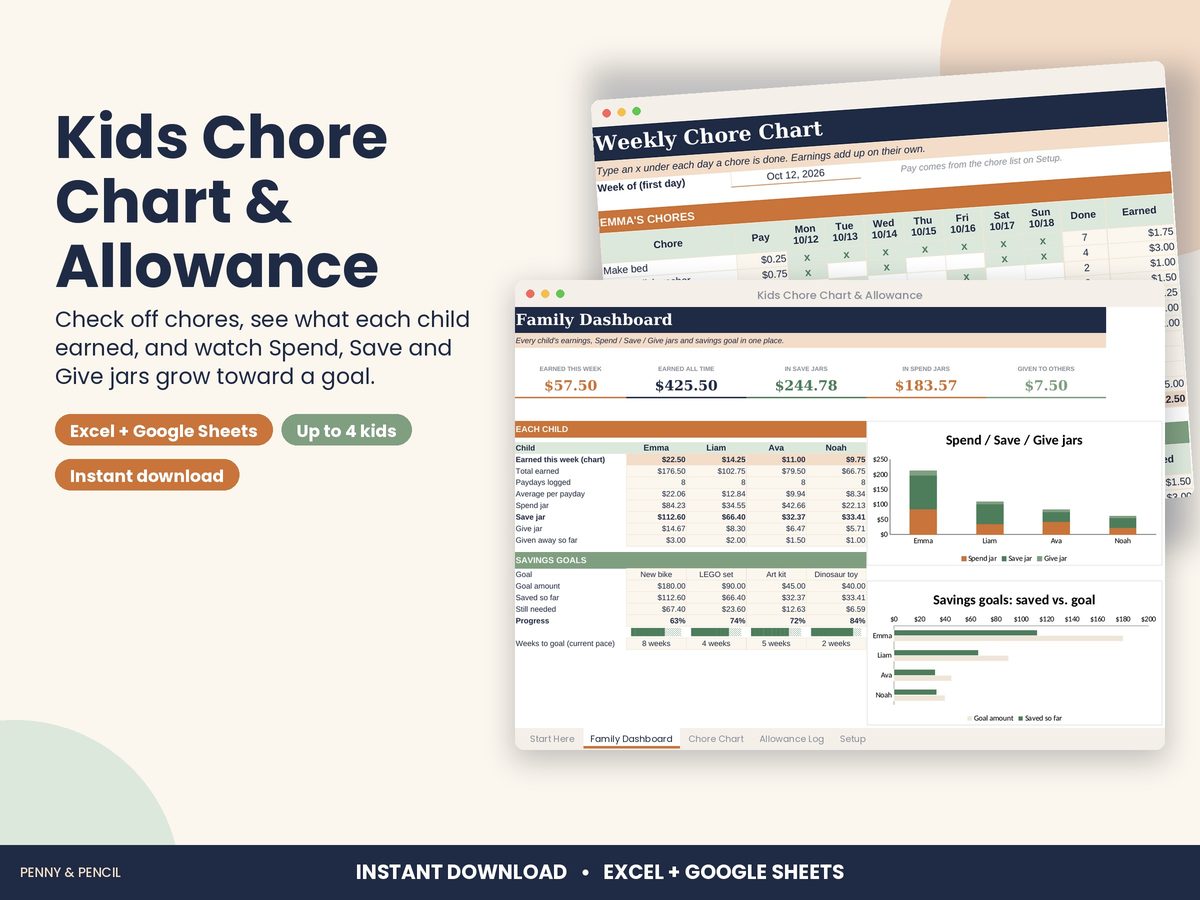
The Kids Chore Chart & Allowance tracker records family entries and applies the Spend, Save and Give percentages you choose. Its dashboard shows jars and goals; it does not teach the lesson for you or guarantee a savings outcome. The email-list chore-chart sample is a separate blank PDF for jobs and days, not this lesson or the paid spreadsheet.
The procedures, questions and worked examples are original illustrative material.
The free download opens when you join our list: join below.
Free downloads unlock when you join our list
Join the Penny & Pencil list once, confirm the email we send, and every free download, printable and planner on this site opens. We send a welcome note, deals, and one email every two weeks.
You are in. Your free downloads are unlocked on this page.